Zero Distribution

When is a pirate not a pirate?

I can hardly go to see a movie now, or pop a newly purchased DVD into my player, without somebody screaming at me that piracy is wrong wrong WRONG! Don’t I know, the disc I just purchased with my own money for twenty bucks tells me, that I’m stealing food from the mouths of hungry studio executives and billionaire stars? Can’t I look into my heart, the giant multiplex screen asks me, and not pirate the movie I bought a ticket for (and sat through twenty minutes of commercials to get to) with that camcorder I don’t have stashed in my pocket?

Oh, fuck off.

I’m a subscriber to Netflix, The Movie Network, HBO and a host of cable outlets. I own thousands of DVDs, all bought and paid for. I’ve suffered inflated entry fees at the box office to see thousands of other films over the years. In the past, when such things were viable, I paid to rent movies on VHS, laserdisc and DVD at a wide variety of video stores and mail-order services like Zip.ca. Over the course of a lifetime of movie fandom, I’ve shovelled six-figures of cash at studios, distributors and venues in order to watch the endless number of films I considered worth my time and attention.

But have I ever illegally downloaded a film to watch on my computer? Ever? Even once?

You bet your goddamn ass I have. Many hundreds of times.

Why is that? Is it because I’m a criminal who can’t wait to fleece those poor struggling Hollywood conglomerates? You know, those wonderful people who keep poisoning the well with nine-figure budgets to produce B-movie crap, colossal celebrity salaries that would be enough for any reasonable person to retire on after just one picture, surcharges on already overpriced tickets for gimmicky 3D bullshit I don’t even want with my movie, endless upgrades to the same popular flicks on DVD, Special-Edition DVD, Extra-Special-Edition DVD, Blu-ray, Super-Duper-Extra-Special-Virtual-Blowjob Blu-ray and fucking 3D Blu-ray? Is it just because I’m such an awful person?

No, actually. It’s because they won’t give me the movies I want to see in a timely fashion. So I look elsewhere.

Let’s look at five recent examples of films I’ve seen fit to pirate (plus one more for further discussion), just so I could finally see them.

Snowpiercer (Bong Joon-Ho, 2013, South Korea)

A dystopian sci-fi train movie from the director of The Host? I had to see this immediately. Thanks to shitty distribution, it bounced around in overseas markets for an entire year before it came to these shores. And only then with no real ad campaign and a limited release in Canada (“limited release” in Canada usually means “one screen in Toronto, fuck everybody else”). So I downloaded a copy because it was already out on Blu-ray in foreign regions. And you know what? I’ll buy a DVD when one’s finally made available anyway.

Dom Hemingway (Richard Shepard, 2013, U.K.)

There’s a new Richard Shepard movie out with him doing for Jude Law what he did for Pierce Brosnan in The Matador? Where can I buy a ticket? Nowhere? But it’s been out in the U.K. for nearly a year. Tough shit, because there were low expectations for its box office potential in North America. Oh, they got around to a limited release eventually. In the meantime I downloaded a copy because it was already on Blu-ray in the U.K. And you know what? I’ll buy a DVD when one’s finally made available here too. Because I want my Richard Shepard collection to be complete – even though there are titles that have never been released on DVD, and the interlacing on the disc for The Hunting Party was all fucked up (Thanks, Weinstein Company! If you need some help on the technical side next time you digitally transfer a film, let me hook you up with a twelve-year-old nerd who knows what he’s doing).

Only Lovers Left Alive (Jim Jarmusch, 2013, U.S.A.)

A Jim Jarmusch film starring Tilda Swinton as a vampire and set in the ruins of Detroit? I’m so in! I’ve known about this project since Jim was still trying to finance it. And then it finally got shot in 2012. And finished in 2013. And released in 2014. On four screens. In the States. I got so sick of waiting to see it, I finally downloaded a copy with burnt-in Asian subtitles. Not an optimal way to see it, but at least I got to see it before I dropped dead of extreme old age. And you know what? I’ll buy a DVD when one’s finally made available. I even keep my pirated copy in a folder with other films called “Buy and Delete.”

Five Graves to Cairo (Billy Wilder, 1943, U.S.A.)

How did I get this far in life without seeing this classic bit of Billy Wilder wartime espionage propaganda? Easy, I couldn’t find it. But you know who had it? One of the pirate sites that respects film history (unlike the people who own the rights to all that film history). And you know what? It turns out a DVD was released only last year. Seventy years after the fact, but who’s counting? I would have bought it had it been made available in a timely fashion, right around the same time I bought EVERY SINGLE OTHER Billy Wilder movie that was out on DVD. I mean, hey, he’s one of the most beloved writer/directors in history, right? And yet! All of his films STILL aren’t out on DVD, 17 years into the format.

Bad Company (Robert Benton, 1972, U.S.A.)

I got tired of having not seen this early Jeff Bridges acid western, so I went shopping for the DVD. Only then did I discover it was out of print. And I really didn’t want to pay 30 bucks for a crappy old transfer on the secondary market. Except I probably will now because having downloaded and watched it and really liked it, I want a better copy than the even-lower-rez download I found. Too bad no one’s looking to release an upgraded special edition of this DVD. Nah, they’re probably hard at work on the tenth edition of Army of Darkness. Fine film, sure, but who needs ten DVD copies of it?

I usually watch movies on the basis of who wrote and/or directed them. I have a long list of people whose careers I follow closely. One of those people is Terry Gilliam. Obviously. If you haven’t been following his career for decades, then I guess you don’t particularly care for cinema in general. I own all of his films on DVD, including multiple editions of some. And I’ll be buying The Zero Theorem one day too. But I’ve also pirated it. Why? Because it was recently announced it’s not even getting any sort of theatrical release in Canada. A Terry Gilliam film. No release. For real.

Mongrel Media has since backed down, embarrassed into offering some sort of Canadian distribution after an email campaign by fans shamed them into it. But why was that even necessary? Simple really. The bottom dollar.

The Zero Theorem is one of those odd, contemplative, existential science fiction movies filled with mystery and symbolism and metaphors that need to be deciphered, capped off with a big fat ambiguous ending. Marketers have no idea what to do with one of those. It’s a lost cause. Better to wait for the next bang-bang shoot-em-up-with-lasers science fiction movie to dump their ad campaign dollars into.

As for me, two words, “Terry” and “Gilliam” sold me instantly. But I’m not most people. Hell, they couldn’t even convince people to go see Tom Cruise blow up aliens in Edge of Tomorrow. They’re never going to convince Joe Boxoffice to buy a ticket to see a bald Christoph Waltz feel alienated while he works on an insolvable problem from his home computer. It was a business decision, pure and simple. To save face, Mongrel will probably end up giving it a token limited release. You know the drill. One screen in Toronto. Two weeks tops.

So where does that leave someone like me? Downloading a torrent, of course. And no, I’m not a bad person for doing it. I’m not stealing the last morsel of bread from Gilliam’s children’s mouths. I’m just a film fan who wants to see the fucking movie now because I might get hit by a bus tomorrow. If it’s finished and ready for public consumption, make it available. There’s a world of technology that makes this possible, guys. Figure out the business model and make it work. And stop trying to sell me on the idea of commuting to see it on the big screen at an inconvenient time, after a bunch of ads for products I’ll never buy and a bunch of trailers that spoil the plot for every movie they’re promoting, next to a mob of chattering troglodytes eating stinky nachos and lighting up the dark theatre with their smart phones while they check to see if they got any interesting texts in the last five minutes.

That ship has sailed. I officially hate the theatre experience now. I have better picture, better sound, better company, and better odours at home. Now let me watch what I really want to watch when I want to watch it instead of spoon feeding me another fucking Transformers movie.

“But it’s the big screen! Some movies are meant to be experienced on the big screen!”

Fuck your big screen. And fuck that wad of gum that’s been stuck to it since some idiot threw it up there in 2003. Don’t you guys ever scrape that shit off?

The Zero Theorem is a dystopian-future science fiction piece, and like all science fiction, it’s really about the here and now. Dystopian-future speculation has been around for a long time, often as cautionary tales about current trends and where we’re heading. Whether it’s Brave New World, 1984, Fahrenheit 451, Brazil or Blade Runner, they’re always slightly ahead of the curve – warning of present dangers, but anticipating how bad things might get down the road. Increasingly, however, such works of satirical speculative fiction have felt closer and closer to the mark. Or, more to the point, the world we’re living in has at last come to meet the lowest expectations of Huxley and Orwell.

Now that we’ve finally arrived at the dystopian future we’re all been waiting for, I find I don’t much care for it. Between the surveillance state wanting to know what we’re all up to every moment of every day, and corporate marketers wanting to track every transaction we make so they can better predict how to pick our pockets, I long for the good old days when the only thing looking over our shoulder was the grim reaper – because the black death was sweeping across Europe. Again. And kings and queens were plotting the next major war/population cull. Again. Things were simpler then. Deadlier, but simpler.

The Zero Theorem presents an all-too-recognizable future filled with isolation – isolation through technology, isolation through shallow human interaction, isolation by choice. Christoph Waltz is Qohen Leth, a man utterly alone, who nevertheless always refers to himself in the plural. He’s the latest in a series of computer technicians tasked with solving the zero theorem – an equation that will prove that one day the reverse of the big bang will occur, unmaking everything. He’s good at his work, but largely disinterested in what it’s all for. Unwelcome visitors thwart his ability to concentrate on what he’s doing and demand he form human bonds he doesn’t understand and has long avoided.

It is not an easy film. You will be left with questions like, “What did I just watch?” “What did it mean?” and “Did I like that or hate it?”

You should see it sometime. A time of your choosing, in a format of your choice. Just as soon as the distributors finally pull their thumbs out of their asses and offer it to you.

Or go ahead and find another way. We may be living in our very own dystopian future, but at least it gives us technological options when it comes to how we legally or illegally consume media.

Christoph Waltz plays a character who doesn’t want to be noticed, Matt Damon plays a character who literally blends in.

Christoph Waltz plays a character who doesn’t want to be noticed. Matt Damon plays a character who literally blends in.
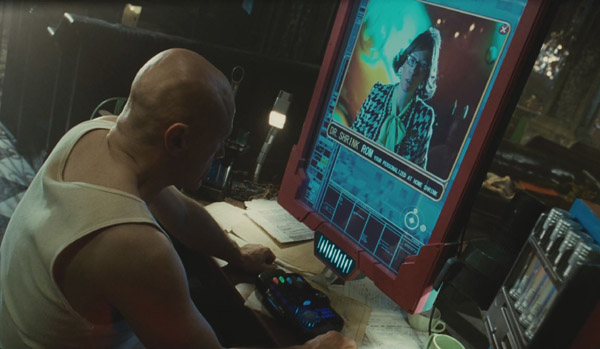
Christoph Waltz seeks virtual psychiatric from a programmable Tilda Swinton.

Christoph Waltz seeks virtual psychiatric help from a programmable Tilda Swinton.

zerotheorem03

Christoph Waltz and Mélanie Thierry share one of those obsolete genuine human interaction moments.

Dystopian futures have lots of rules.

Dystopian futures have lots of rules.

Playing spot-the-symbolism will keep you busy throughout the 106-minute running time.

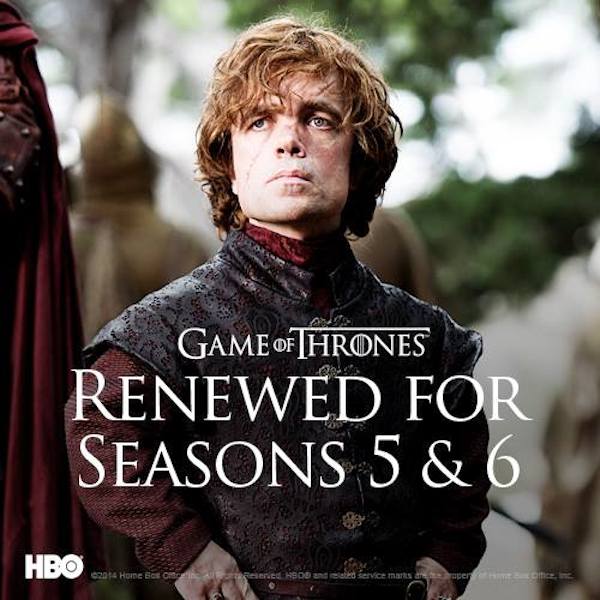
Playing spot-the-symbolism will keep you busy throughout the 106-minute running time.

Pucca Break

I’ve been off the show for years and there hasn’t been a new episode of Pucca produced in a very long time, but the cutsie kung-fu powerhouse is still going strong. Pucca cartoons continue to sell across the international market generating not one, but two royalty cheques I’ve received in recent months. Merchandise circulates all over the world as evidenced by the t-shirt of this adorable little Brazilian girl who appears to be standing next to a gigantic pair of OH MY GOD!!!!!mr-balls

You didn’t just see that. Whatever that was. Please click this EMERGENCY ESCAPE LINK to get the hell out of here.

A Survival Guide to Westeros

Recently, I saw an online poll asking people which fantasy world they’d most like to visit. And despite so many voters expressing their desire to travel through the fictional lands of their favourite books, films and television shows, I didn’t see much personal appeal. Neverland? Nah. Too many eternally youthful juvenile delinquents up to no good. Oz? No way. Flying monkeys are creepy as hell. Narnia? Pass. Allegorical anthropomorphic Christ-lion messiahs aren’t my scene.

Nobody chose Westeros, home of George R.R. Martin’s Game of Thrones machinations and mayhem, because it’s too violent and dangerous. I think they’re missing the forest for the trees. The thing about Westeros, the real selling point, is that EVERYBODY gets laid. There is so much fucking going on in the seven kingdoms, it’s amazing anyone finds any time to get some beheading and backstabbing in.

Dwarf? Doesn’t matter, you’re a pussy magnet. Vow of celibacy? A ginger savage will still bang your brains out. Have to pay for it? Totally worth it! Westeros prostitutes are universally gorgeous and disease-free. Even most of the eunuchs in the land are hunks and could easily get some if they were so inclined (and rented the appropriate prosthetic). You can pretty much trip, fall and find yourself intimately entwined with a total hottie before you even hit the ground.

Okay, granted, the entire book/TV-show world is a death trap. Life expectancy is low, main characters die off so fast it sometimes feels like the entire cast must have contracted Ebola, but what a way to go! If you want to risk it and join the fantasy fuckfest, here’s a simple guideline to surviving in the lands of Westeros and Essos:

Be an outcast, either too tiny or too enormous. If you weren’t lucky enough to be born a freak, try being disfigured or maimed. Terrible scars may be your ticket to a long life. Losing a limb is golden. Don’t forget, cock and balls count. Think you’ll miss them? Well would you rather be dead? Trim those boys off while there’s still time. Don’t want to have your body all cut to pieces? Fine. Become a cripple.

Fat is good, stupid is better. Hedge your bets and try being fat and stupid. DO NOT be handsome or beautiful because one day you’re going to pay for that shit. If you’re at all good-looking, try getting maimed as soon as possible. Whatever you do, don’t be popular and well-liked. That’s an instant death sentence.

As predictable as this formula is, however, all bets are off when enormous versus disfigured in a fight to the death. That’s like an unstoppable force meeting an immovable object. Oh, right. Spoiler alert. Sorry, but you’ve had a whole week to get up to date with your PVR.

This insight comes from having watched the entirety of Game of Thrones in a very short period of time. I’m not one for binge watching but, having said that, I did watch the first thirty hours of the show in three days flat shortly before season four began airing. After such an overdose, it was painful to have to wait a whole week between episodes. Now that the current season is done, I’m probably going to lose my shit waiting for season five to premiere in April 2015. This past Sunday marks the first I’ve had to endure without a new episode. I’m not looking forward to the many more that will follow.

Now I know what all the fuss is about. Game of Thrones is the best thing currently on TV, even if I have cracked the life-or-death code. It’s not my favourite thing (that’s still Sherlock), but it’s a close second.

As we all keep vigil for the return months down the road, let us remember one thing: In the game of thrones, you either win or you die. Regardless, you’ll get a piece.

At least on The Walking Dead, when they kill off a character, the actor usually gets up to take a bow.

At least on The Walking Dead, when they kill off a character, the actor usually gets up to take a bow.

Black Chaos

One of my old short stories has just been reprinted in a new anthology of zombie yarns from Big Pulp. Carrion Luggage originally appeared in the collection, Island Dreams: Montreal Writers of the Fantastic in 2003. Usually I’m happy to use this website as a dumping ground for past material, but when I heard about the upcoming untitled anthology (now named Black Chaos: Tales of the Zombie) I thought this might tickle their fancy and offered them the rights. Everyone’s so eager to write new flesh-eating undead stories, the traditional voodoo zombie has become sadly neglected over the years. I figured this story might help fill a void.

blackchaoscoverblackchaosbackBlack Chaos is available in both print and e-book formats from outlets like Amazon. And if this puts you in the mood for a zombie movie or three, why not give the Romero derivatives a break and visit voodoo classics like White Zombie, I Walked with a Zombie, and The Serpent and the Rainbow for a change. I wish there were more entries in the meagre voodoo-zombie sub-genre to recommend, but after those three I’m already stumped. Okay, maybe, just maybe, Live and Let Die, but now I’m really stretching. Comment below if you know of any more.

Tommy Can You See Me?

If you don’t know about the phenomenon of cinematic awfulness that is The Room, I’m not going to reiterate it here. Just go read the wiki article about the film and the madman behind it, Tommy Wiseau.

After watching it once, years ago, I thought I was done. I can’t say I ever climbed on board the ironic-cult bandwagon that surrounds what has become everyone’s favourite bad movie since Plan 9 from Outer Space. If anything, I was always a tad more intrigued by the backstory of After Last Season, a much worse movie on every level, but not as entertainingly bad as The Room. Whereas absolutely everything in After Last Season is wrong (every shot, every line, every prop – something is always so very off), the attraction of The Room is the wrongness Wiseau brings to the proceedings as writer, director, producer and star. Everyone else involved in the film is trying to make sense of it all (including a fair number of genuine industry professionals behind the scenes), but none of them can make any headway against the madness-tsunami that is Wiseau. He tears the whole six-million-dollar self-financed vanity project down around him, and there’s nothing anyone can do to prop it up. It’s fascinating to watch.

Eventually I ended up sitting through The Room a second time when Cindy, a friend since we both worked on Radio Active so very long ago, poked me (literally) for six months, asking, “When are we going to watch The Room?” She had been introduced to a highlight reel on YouTube and had become obsessed. My second screening did not disappoint, and I was enlightened as to the benefit of watching The Room with other people who could share in the laughter and horror.

I figured that was it. But recently, word spread that The Room personified was coming to town. The Dollar Cinema (long misnamed since admission is now $2.50 for regular screenings) was hosting a special event with Tommy Wiseau himself, and co-conspirator, co-star, co-producer Greg Sestero. How could we not go?

A trio of us took an afternoon excursion to the Decarie Square mall – one of those economically depressed shopping malls so dead, it would be perfectly safe to seek shelter there in a Dawn of the Dead scenario. Even the zombies would find better places to hang out during the apocalypse. I’d bought tickets online a few days earlier, and although we’d heard the show had sold out, we were unprepared for the epic crowd.

“This mall hasn’t had this many people in it since the ‘80s,” I declared. And I wasn’t joking. I think that was an accurate assessment. We were the better part of an hour early, and already the line of ticket holders was long. It would double by the time we were let in. There was even a lengthy line of people waiting for standby tickets. An entire second screening had been scheduled to meet demand, and it looked like it would be no less crazy.

An pre-movie opportunity to buy merchandise, meet Tommy and Greg, and get shit signed was offered and seized by Cindy and myself. Knowing there was a recent book about the production by Sestero, I took this moment to buy a copy. I’m halfway through The Disaster Artist now, and it’s kind of magnificent – certainly the best Hollywood-underbelly book I’ve read since Nightmare of Ecstasy. It’s a compelling story in the genre I like to call “Normal guy tries to be buddies with weird guy.” As such, the book is a modern day Of Mice and Men, with Tommy in the role of Lennie, excepting the fact that fewer puppies and pretty girls get accidentally strangled. Okay, maybe it’s just a modern day The Cable Guy. Either way, it’s rocketed to the top of my recommended reading list.

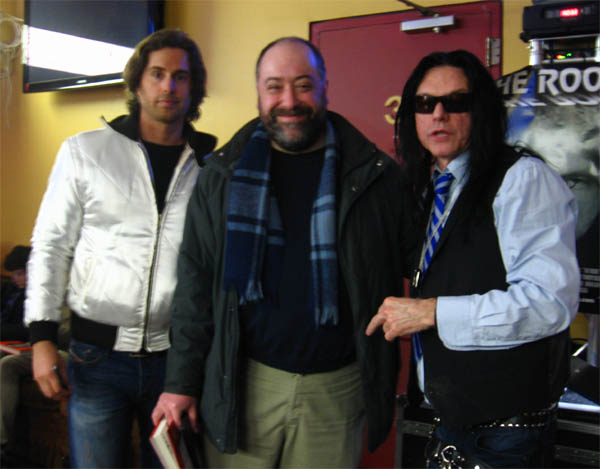
Film industry titans, Greg Sestero, myself and Tommy Wiseau. Photo by Lucinda Davis. NB: Greg is wearing a knockoff of the scorpion jacket worn by Ryan Gosling in Drive. Unless, of course, he defeated Gosling in a duel and skinned him alive.

Film industry titans, Greg Sestero, myself and Tommy Wiseau. Photo by Lucinda Davis. NB: Greg is wearing a knockoff of the scorpion jacket worn by Ryan Gosling in Drive. Unless, of course, he defeated Gosling in a duel and is wearing his skin as a trophy following his victory.

Intriguingly, Greg Sestero crossed out his own name before signing. Insanely, Tommy crossed out co-author Tom Bissell's name before signing.

Intriguingly, Greg Sestero crossed out his own name before signing. Insanely, Tommy crossed out co-author Tom Bissell’s name before signing.

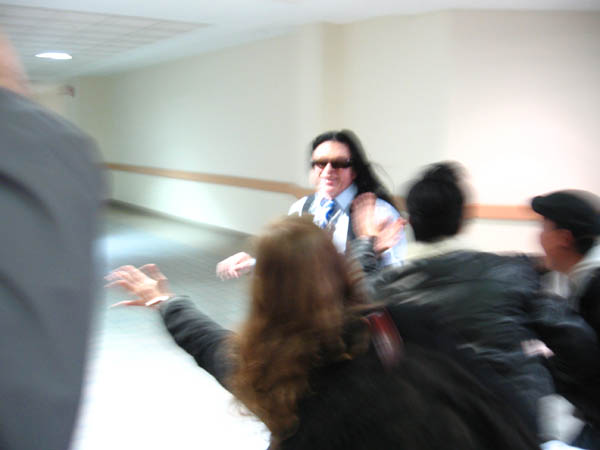
Back outside and in line, we heard the crowd erupt into cheers and hoots. Tommy had decided to come out and bask in the love, running the length of the queue to deliver as many high-fives as he could to his adoring fans. Tommy doesn’t seem to smile much (unless you count those unnerving humourless chuckles from his bag of acting tricks), but there seemed to be genuine joy on his face in this moment. He looked like a big shaggy dog let off his leash in an open field after being cooped up in the house all week.

The Running of the Tommy.

The Running of the Tommy.

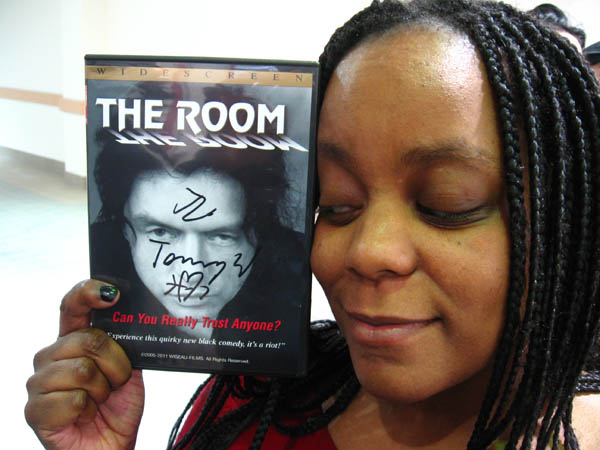
Cindy looks adoringly at her signed DVD. The ladies get an extra heart-and-arrow scribbling on their merchandise.

Cindy looks adoringly at her signed DVD. The ladies get an extra heart-and-arrow scribbling on their merchandise.

Pete models the sexiest piece of Wiseau memorabilia offered to fans. We can only hope each item was pre-worn by Tommy himself. I know I'd rather have his name on my underwear than that goddamn Hilfiger creep.

Pete models the sexiest piece of Wiseau memorabilia offered to fans. We can only hope each item was pre-worn by Tommy himself. I know I’d rather have his name on my underwear than that goddamn Hilfiger creep.

The Running of the Tommy Part II: The Rebound Lap.

The Running of the Tommy Part II: The Rebound Lap.

Inside the theatre, we were subjected to a surreal Q&A session with the featured star duo. I usually find screening Q&As tedious, filled with bad and awkward questions from the audience that really bring the mood down. In this case, nothing could bring the mood down. It didn’t matter what was asked of him, Tommy was quick with answers that came directly from an alien world in an alternate universe. He was multitasking bizarre queries, photo requests, and film-scene re-enactments in a way only someone completely uninhibited can. It’s astonishing how much you can accomplish when you don’t think about anything before you say or do it. Tommy just runs with it, whatever it may be. He may not arrive anywhere that makes the least bit of sense, but dammit, he’ll get there.

The Q&A. We sat near the very back because we didn't want to get pelted by plastic spoons the whole movie. It was a wise move.

The Q&A. We sat near the very back because we didn’t want to get pelted by plastic spoons the whole movie. It was a wise move.

Pete assumes the crash position, doubling over with laughter during Tommy's barking-mad responses. Cindy watches with awe, admiring a true thespian at work.

Pete assumes the crash position, doubling over with laughter during Tommy’s barking-mad responses. Cindy watches with awe, admiring a true thespian at work.

In the decade-plus since its release, The Room has very much arrived at a Rocky Horror level of cult. I knew about the spoons that would be thrown, the footballs, the people who would inevitably arrive dressed as their favourite character. But I didn’t expect the audience interplay with the film to be as solid as it was. There were some classic reply lines, sing-alongs and Mystery Science Theater 3000 moments. In this post-Oscar season, what’s to be said when the most entertaining picture I’ve seen lately is a piece of crap from 2003 I’d already watched twice before?

Of course, in the wake of this, Cindy wants to watch After Last Season, complete with its paper sets, paper MRI machine, and paper-thin acting. I don’t know if it can hope to match the magnificence of The Room should we gather an audience, but I expect we’ll find out soon enough. The poking has begun, and past experience has shown I can only bear that for six months max before my resolve crumbles.

The Five Most Unkillable Characters on The Walking Dead

I hate how trendy zombies have become. What used to be a tiny niche of a horror subgenre has become an overexposed industry. Zombies have become tedious in much the same way Anne Rice and Stephanie Meyer made vampires tedious. Admittedly, zombie romance isn’t that prevalent (although it certainly exists) and I’ve yet to see a single flesh-eater sparkle in the sunlight, but the ghouls have gone from horrifying and nightmarish to mainstream and cuddly.

That’s the downside. The upside is that there’s so much zombie product being churned out for all forms of media, the law of averages dictates that at least some of it turns out to be excellent.

I’ve been a zombie advocate for many years, dating back to where there were scant few examples of this now-ubiquitous trope. In the days of my youth there were only four viable entries in the cinematic niche of flesh-eating reanimated corpses: Romero’s Living Dead trilogy (back when it was only a trilogy) and the branching sequel Return of the Living Dead (the best of the zombie comedies until Shaun of the Dead arrived many years later).

And no, do not talk to me about Zombi 2 (the Italian pseudo-sequel to Dawn of the Dead – which was released in Italy as “Zombi”). Sure it had a classic injury-to-eye moment, but that’s pretty much the only thing in the entire movie that wasn’t stupid and worthless. One good gore effect does not a good zombie film make.

These days, in the midst of this glut of new material, some projects stand out amongst the fad’s cash-in fodder. The Walking Dead, now in its fourth year on AMC, is at the head of the pack – an ambitious, epic tale of survivors (who frequently fail to survive at all), derived from the hit comic book series of the same name. Fans have been left hanging since the mid-season climax late last year, waiting for the second half to pick up from the wrenching events we last witnessed. That’s the thing with The Walking Dead – you’re compelled to keep watching, even though you know awful horrific things are going to keep happening, often to a character you like.

WDdontlookbackAs a professional screenwriter, I always watch shows with a mind bent on figuring out who might live or die, who’s guilty of a crime, or which couples might pair up. I don’t do this by examining evidence and making sound deductions. I do it by observing character arcs and determining who has been played out, built up, purposely sidelined, or creatively cast. It’s a talent and a curse. I’m rarely surprised (Games of Thrones’ red wedding only elicited a shrug and a “meh, figures” from me rather than the intended horror and disbelief, for example) but I do still derive pleasure from watching a magic trick well performed, even when I know how it’s done on a technical level.

Since The Walking Dead has a reputation for being an anybody-can-die-at-any-time kind of show, I thought I’d put my money where my mouth is and make a few predictions. Here are the five most unkillable characters, according to me. Rest assured, if you like them, they are in no imminent danger. Unless I’m full of shit.

Number One: Carl. You can’t kill Carl because he represents hope for the future. He walks the road to hell like a post-apocalypse Daigoro to his father’s Ogami Itto. We may be seeing the story unfold largely through Rick’s eyes, but his experiences ripple down to his son. Whatever lessons Rick learns along the way, are ultimately Carl’s to benefit from and to carry into the post-post-apocalypse period, some time currently unforeseeable, when the dead stop walking the Earth.

Number Two: Daryl. When he made his first appearance in season one, he looked like trouble. I had him pegged for the first live human who would have to be murdered for the safety of the group. But removed from the bad influence of his brother, he started to come around. Then he got awesome and quickly became a fan favourite. Although the TV series isn’t married to anything that’s happened in the comic book source material, Daryl’s ultimate fate is wide open because he’s one of the few major characters created exclusively for the show. As long as fans keep cheering on the crossbow-wielding hick, he’s safe. And why would they stop cheering him on? I mean, the dude TOOK OUT A TANK single-handed in the mid-season climax. He’s a goddamn superhero.

Number Three: Rick. Killing off the main character would be problematic, but not impossible. It’s highly unlikely they’ll ever get rid of the character, except perhaps in a series finale. The only thing that could do Rick in before that moment is a bad round of contract negotiations with Andrew Lincoln’s management. If an actor becomes too expensive, the writer’s room will be given the task of disposing of him quickly and brutally. Money is king in Hollywood, and nobody is indispensable if they threaten the bottom line.

Number Four: Michonne. I won’t discount the possibility of her going out in some heroic blaze of glory in a future season, but right now she’s far too awesome to dispatch. I’m not making a serious romantic prediction here, but I feel I should point out that if Daryl and Michonne hooked up, they could repopulate the world with a warrior caste of asskickery. I also think they’d make a cute couple because Michonne has melee encounters covered with her katana, while Daryl can lend support with ranged combat. Oops. Sorry, that’s my video game/RPG geekiness leaking through. This is supposed to be about zombie geekiness. I’ll try not to mix my poisons.

Number Five: Judith. This is going out on a limb because she might already be dead. The last we saw of her was a blood stain in a stroller. But I’m betting she was ushered to safety by her entourage of little-kid bodyguards. The show has been pretty uncompromisingly ballsy, but I don’t think they have it in them to kill off a baby. Not at this moment, at least. As for the comics… Well, we’ve already seen that the original comic books make the TV show look like a Disney cartoon. For example – if you haven’t read the graphic-novel collections – let’s just say that the dispute between Michonne and The Governor was over rather more than a single poked-out eyeball. Killing Sophia was an early indication of the series’ big brass balls, but I know there are some suit-and-tie executives behind the scenes, wringing their hands as they count all the money, worrying that bumping off a baby will alienate too many TV viewers and adversely affect ratings. I’m sure there’s a memo or two circulating the production office to that effect. Whether this is a note or a decree will be confirmed soon enough.

Are these predictions bold or safe, daring or banal? I don’t know. I’m probably just shooting the shit because I like good zombie material and I want to help alleviate some of the viewer anxiety people experience when they watch this sort of thing and fret over their beloved characters who never seem to be free of mortal peril and gnashing teeth.

I know how it feels. I guess I still haven’t recovered from that day I first watched Roger and Flyboy take a bite for the team.

Tumbleweeds at the Box Office

At the end of every December, I’m used to someone asking me what the best film of the year was, because I’m known as the guy who watches shitloads of movies. This is always a hard question to answer, because by the end of any given year I haven’t seen all of the noteworthy movies that came out over the past twelve months. In fact, it will probably take me a few more years to be able to speak definitively on said given year. By now, I feel I might have the authority to weigh in on the best of 2010. I may be pretty solid on 2011. But I doubt I’m fully qualified to eulogize the year 2012 yet, and 2013 is out of the question. Hell, I haven’t even been out to take a look at the second part of The Hobbit. Sure I’ve seen more than most people, but there remain plenty of titles to catch up on.

“What’s the best western this year?”

That was a question I was asked only two days ago. And it was such a specific, narrow question, I had to respond right away. I felt I was qualified to answer this one.

“The Lone Ranger.”

Amidst the laughter: “It was that bad a year for westerns?”

Yes it was. And no it wasn’t.

The Lone Ranger earned this year’s epitaph of “Biggest Box Office Bomb.” And it was hardly surprising. The Lone Ranger has had his day. Starting as a radio show in 1933, the character has been played out. He was a hero once upon a time, harking back to more innocent times, but today appears corny and sentimental. Catch phrases and theme music remain recognizable clichés, but are rapidly fading from the collective cultural memory. This is no longer a franchise brand name that will pack in an audience. Today’s target audience doesn’t know who The Lone Ranger or Tonto is and has no Lone Ranger movie or TV show from their childhood to draw them to the theatre through nostalgic manipulation.

There have been other attempts to dust off the white hat and the black mask. The Legend of the Lone Ranger flopped in 1981, as did a TV movie/attempted pilot in 2003. Not taking the hint, Hollywood took yet another stab at it this year, hedging its bets with much of the creative force behind the Pirates of the Caribbean franchise, including Johnny Depp as Tonto, and a budget and marketing campaign in the hundreds of millions of dollars. The results were disastrous, nobody turned out to see it, and those few who did hated it.

At least, that’s the perception. The reality is a little more complicated.

First off, the film has earned more than 260 million dollars worldwide so far. That’s a lot of bums-in-seats, each of them holding a freshly purchased ticket. In the mad accounting world of contemporary Hollywood, however, this qualifies as a bomb, because the film cost 225 to 250 million to make (nobody even knows for sure because, hey, what’s 25 million more or less, right?), plus another 150 million to market. We’re still in the early days of its DVD release, and it’s barely begun making the rounds of cable TV outlets. Given enough time to accumulate future rental fees and international television broadcast sales, The Lone Ranger might yet break even or turn a small profit. But the perception of it being a bomb will never change (just like Waterworld which, a generation later, is still synonymous with “bloated Hollywood bomb” despite having been in profit for many years now).

But the real question is: is the movie any damn good?

Well, no. And yes.

Gore Verbinski, Jerry Bruckheimer, Johnny Depp, Armie Hammer, and pretty much everyone else involved in the production down to the caterers have all come out and said it’s a misunderstood classic that will be embraced in future years by new viewers giving it a fresh look. They are, of course, wrong. But I understand why they think this, because they were really trying to make a good movie (as opposed to a cynical cash-grab with a name-brand sure thing). And they didn’t entirely fuck it up. Chip away at all the excess and gobs of money and overblown CGI-laden action sequences and you’ll find, lying somewhere beneath the muddled surface, the best possible Lone Ranger movie we’re ever likely to see given the hackneyed concept.

It’s Little Big Man with better old-man makeup, I quipped after my screening. And I wasn’t really joking. The whole movie is told through the eyes of an old, decrepit Tonto – a character who is probably senile at this point, and is certainly (as the rest of the movie testifies) insane. Thus, if everything that follows falls under the “unreliable narrator” literary device, all the crazy shit that unfolds (bad CGI included) is forgivable. It’s rendered acceptable for being how a demented character misremembers the details of his own life.

This jumbled Photoshop nightmare fails as an advertisement, but does convey the busy mess of the film it promotes. Does it represent the story being told, or the crazed ramblings of a mad Indian?

This jumbled Photoshop nightmare fails as an advertisement, but succeeds in conveying the busy mess of the film it promotes. Does it represent the story being told, or the ramblings of a mad Indian?

What ensues in this crazed flashback is a mishmash of aboriginal mysticism, silly action sequences, and a movie that makes the traditional hero the sidekick, and the sidekick the stealth protagonist (a trick you may remember from Big Trouble in Little China – which is an apt movie comparison on several other levels as well). Fun and games and wholesome family entertainment follows – with lots of violence, cannibalism and genocide thrown in for good measure. It’s not so much that the movie can’t pick a tone, it’s that it wants to do a bit of everything and just runs with it.

One explanation we’re given for where Tonto’s head is at in the film is, “His mind is broken.” So is the rest of the movie. Yet both keep moving forward with a dogged determination to see their disorder through to the finish.

So yeah, I guess I kinda liked it. And I’ll still call it the best western of the year, even though there were one or two other entries in the genre worth mentioning. But man, pickings are slim.

Westerns have had a rough time in recent decades. The genre has been declared dead more often than Rasputin. What started as a glut throughout the first sixty years of cinema has tapered off to a few meagre offerings here and there. Occasionally something happens to revitalize the genre, like the spaghetti-western revolution of the 1960s, or the low-key gritty realism Unforgiven brought to the table. But between rare major releases and the occasional indie gem, the modern western wanders lost in the plains. Sometimes a misguided project tries to revitalize the old tropes by adding something to the mix – like vampires or aliens – usually with terrible results. It’s like they’re trying too hard to make people like a genre that’s fallen out of favour, rather than let the western be what it needs to be.

“But I don’t like westerns,” is a lament I often hear.

If you say you don’t like westerns, you might as well say you don’t like stories. Because all a western is, is a time and a place. Once you get past that fact, you can tell any story you care to whatsoever. The big sky is the limit. Even the location and period can be fudged and still have the end result be called a western (witness Lonely Are the Brave, set in its release-date time period of 1962, or Quigley Down Under, which relocated all the familiar trappings to Australia).

Although you can safely declare the chances of a Lone Ranger sequel dead on arrival, the American (and sometimes European) western remains a viable engine that will continue to draw talented writers and directors to try their hand at it. How many investors and moneymen it draws in future is another matter. The damage a 400 million dollar perceived failure causes will ripple for years. Don’t expect any giant-budget westerns to be greenlit for a long time.

Luckily, the best westerns tend to be the product of modest budgets. I hope to have a better answer at the end of 2014 should someone ask me again, “What was the best western this year?”

Sweetwater gets honourable mention for being the most nihilistic western of the year. NB: This one was shot, with a cast of names, for only seven million. It probably didn’t make its money back either.

Sweetwater gets honourable mention for being the most nihilistic western of the year. NB: This one was shot, with a cast of names, for only seven million. It probably didn’t make its money back either.

Because Their Lips Are Moving

My international readers may be perplexed. The Great Canuck Scandal continues to unfold on a daily basis, but I have steadfastly refused to stand up and try to explain it to them. And really, you do need a local guide to explain the phenomenon that is Toronto Mayor, Rob Ford. I’m a Montrealer, so like the rest of Canada and the rest of the world, I can watch this gruesome road accident with a sense of bemused detachment. Because really, this is all on Toronto, not Canada. And where it concerns the rest of Canada, the attitude, quite correctly, is “Fuck Toronto.”

Ultimately, this whole mess can be explained by simple math. Rob Ford happens when you create a mega-city that results in the sprawling suburban wilderness of banjo-pickin’ hosers having the majority of the vote. When that happens, it no longer matters what all those people in the densely packed city ridings want, it’s the sparse, remote ridings, legion in number, that get to decide the important stuff. Like who gets to be mayor. Democracy, they say, is two wolves and sheep voting on what to have for dinner. Witness democracy in action. And Rob Ford likes his mutton.

Alas, I was really trying to avoid comment on the whole Rob Ford affair. For comedic purposes, it’s like shooting fish in a barrel with a howitzer. I prefer a bit of a challenge. I don’t feel like I must go after the low-hanging fruit all the time. I’m a reasonably tall man. I can reach the mid-level fruit just fine.

Rob Ford has been nothing if not an embarrassing wealth of riches, and not just because he’s a spoiled rich kid who has politically managed to pass himself off as some sort of regular-joe common man. Every damn day, literally, there’s a new video or quote that surfaces that could scupper any normal political career. But you can’t squash this cockroach. Mostly because he’s too gigantic to squash – both in size and ego.

The honourable Major of Toronto, Robert Bruce Ford. He ain’t leavin’.

The honourable Major of Toronto, Robert Bruce Ford. He ain’t leavin’.

Weathering the crack smoking, the binge drinking, the drunken stupors, the gangsterism, the murder allegations, and the pussy-eating has been a noble task that deserves respect. I don’t mean Rob Ford, I’m talking about myself. I sat through all that and barely even cracked a joke on Facebook. This, my friends, is discipline.

But now the scandal machine has entered the theatre of television production and I feel a line has been crossed. I simply must comment on the recent cancellation of the Sun News Network show, Ford Nation, after only one episode that brought in the single highest ratings the SNN has ever seen in its existence.

The excuse for the abrupt death of what was to be a weekly commentary show was that it was too costly to produce. At five hours to shoot, eight hours to edit, it simply wasn’t feasible to move forward, so they dumped the Fords and the ratings bonanza they brought with them.

Lies, all lies. Big fat stupid lies.

So how do I know these television suits are lying?

Well, aside from the fact that they never stop lying, none of what they said makes any sense. A five-hour shoot and an eight-hour edit for a one-hour show that only airs once a week is NOTHING. Especially for a pilot. A new show is going to take a while to iron out. The machine needs time to get up to speed. Thirteen hours of shooting and cutting your debut episode is actually a brisk pace, and that length will only get shorter with experience. Claiming a talking-head format is too expensive after one episode is ludicrous. First of all, they already had a budget, so they knew what sort of money they were talking about. Maybe they had to pay a bit of overtime to the crew while the Fords got acquainted with how production works, but that would taper off in time. Most importantly, the show brought in the numbers they were expecting – or more. It was their highest rated show! EVER. You simply don’t walk away from that.

What can be read between-the-lines is transparently obvious. The Fords are a pair of globally embarrassing fuck-ups. Just because the eyes of the whole world are on their antics right now isn’t an excuse to give these guys yet another platform to say stupid shit. Sun News Network got hammered with criticism when they cut this deal earlier this month, and the backlash was waiting to strike with even more intensity after the premiere. The decision to cancel was probably made before a single foot of tape rolled. The fact that a first episode was shot and aired at all probably had more to do with contractual obligations than any actual desire to go through with this shameful train wreck.

So knowing the truth that lies just below an easily scratched surface, what have we learned? Well, the lesson I take away from this is that no matter how obscure the footnote or rare the circumstances, history repeats itself. Even television history.

Rob and Doug Ford opine about The Great White North. Does this look expensive to you?

Rob and Doug Ford opine about The Great White North. Does this look expensive to you?

The last time a top-rated show got cancelled because a network executive had a crisis of conscience and decided it was too stupid to air was Gilligan’s Island in 1967. That’s because, under any normal circumstances, THIS NEVER HAPPENS. Here Comes Honey Boo Boo is still running. These people have no shame. They will broadcast absolutely anything if they can get it past federal regulatory standards and enough morons tune in to watch.

But the SNN can’t cop to the truth and admit a mistake, even if that’s the best possible out and apologizing is the Canadian national sport (narrowly edging out hockey). So when the Fords got pulled, excuses had to be made. Sun simply saying they dropped the show because it was the right thing to do and it was a terrible mistake to ever give these two blithering assholes a forum would have been too honest.

And honesty is poison in the TV biz.

Those Who Can’t

If you’ve ever tried your hand at screenwriting, some well-meaning idiot has probably recommended or bought you a copy of Syd Field’s book, Screenplay. Maybe you were the well-meaning idiot and got it for yourself.

Inside, you’ll find all sorts of discussion about the mechanics of screenwriting that make it look, quite literally on some pages, like a physics formula. The great innovation most frequently pointed out, is how the book postulates that everything can be broken down into a three-act structure. Gee, you mean stories have a beginning, a middle and an end? That’s fucking gold. Good thing Syd figured that one out for us or we’d still be telling knock-knock jokes with no set-up in the middle.

Obviously, I’m not a fan. Syd Field just died, which probably means now is an ill-timed moment to get all critical and mean. But the tributes and eulogies I see out there on the web have put me in a foul mood. And this particular foul mood is as good an excuse as any for me to vent about the phenomenon of screenwriting gurus.

Pass.

Pass.

Syd Field’s book, for all the damage it’s done with its dry, lifeless deconstruction of what should be an art form, can at least be had in second-hand bookstores for a few bucks or, more appropriately, at garage sales for a quarter. That’s really the best thing I can say about it. It’s a cheap read, and there are so many copies in circulation, you can probably snag one for free (or thereabouts) will little effort if you feel you MUST have a look. Attending a Robert McKee seminar, however, will run you more in the neighbourhood of a thousand bucks a pop.

McKee has made a cottage industry (and fortune) with his lengthy and often packed seminars that break down a screen story into more physics formulas and geometic objects with seemingly random but supposedly insightful things written on each point. And people eat this shit up, swearing by it as they go home to work on their feature-length screenplay that will never make it past a single studio reader, assuming it ever actually gets finished and sent somewhere. As part of its marketing, these seminars like to drop the names of famous past attendees who could afford it, but should have known better than to go.

If you’re one of the Field or McKee disciples, fine. I don’t want to get in an argument with you. I’ll just call it a load of crap and you can hurl insults at me as I walk back to my computer to do some more paid screenwriting (or, let’s be honest, play video games – which I can at least afford to do most of the time because people actually pay me money to write for the screen, so there).

Whether it’s dinosaurs like Field or McKee, or any of the next generation of self-styled teachers trying to turn a buck telling you how to break into the biz with a perfect act structure and twists that happen on precisely the right page, they’re all kindred spirits. These aren’t screenwriting sages or gurus. They’re Amway salesmen. They’re exactly the same breed of people who write books and run seminars on how to flip houses for quick cash, or how to day-trade your way to millions. The crap they’re talking about isn’t where they made their fortune. They make their money from suckers who pay them to impart this vast, dubious insight they claim to have. Then they skip town with your dough in their pocket, while you try to earn a living based on the line of bullshit they just strung you.

Take a closer look at these screenwriters who have written how-to books or climbed a stage for a fee in order to educate the hopefuls and you’ll notice they all have one thing in common: You don’t want their career.

If you truly want to write movies or television and you feel you need guidance, the first thing you need to do before buying somebody’s damn book is to look up their credits. It’s just an imdb search away. Then ask yourself, “Is this the sort of success I hope to replicate?” Spoiler alert: it isn’t.

Syd Field wrote three episodes of a TV show and a documentary back in the ‘60s. He’s also credited with a “story concept” for a 2002 short. Robert McKee wrote one episode each for four different television series between 1979 and 1991. Then he wrote a TV movie bible-pic in 1993. Nothing since.

These are their produced credits, which are the only kind of credits that count in the business.

“Yeah, but they probably sold a lot of options.”

A monkey scribbling on the wall with its own poop can sell an option. I’m not impressed.

If you’re considering screenwriting as a vocation, chances are you have certain movies and careers in mind. You want to be a Shane Black or a Frank Darabont or a Coen Brother (pick one at random, it doesn’t matter, they share a brain as well as a filmography). Well guess what, they’re too fucking busy making movies to write you a self-help book telling you how to be them. There aren’t many real screenwriters, be they of the famous millionaire ilk or just stiffs like me working in the trenches, who are going to take the time out to play sensei and guide you to hone your craft and have a fruitful career. We don’t need the competition.

Look, you don’t want my screenwriting career either, but I’m not trying to sell you a book or a speaking engagement. I just want to stick it to all the so-called gurus out there by stealing their thunder and giving it away for free. No bullshit, I’m going to tell you how to be a screenwriter in one minute flat. It’s what I call my two-step program. I’m focusing on movies here because nobody ever starts out wanting to be a TV writer. Nobody. But the lessons learned will apply should you be lucky enough to end up milling product for the boob tube.

Step One: Watch every movie you’ve ever heard about. Read about film and watch anything that gets discussed or deemed noteworthy, be it good, bad or indifferent. Find lists about notable movies, watch them all. Read Danny Peary’s Guide for the Film Fanatic (or just get the list) and watch everything mentioned. Have you seen all the top 250 films on the imdb? If not, fix that. How about the bottom 100? Fix that too. Watch whatever has been scrutinized, analyzed or talked about in every genre. Don’t like westerns? Tough shit, watch ‘em. Offended by porn? Get over it because there are important titles in sleaze, too. Hate chick flicks? Man up and stare them down. You say you don’t like to read subtitles? Well get out your reading glasses because there are heaping piles of foreign cinema you need to watch. Didn’t understand one of the famed ambiguous movies? Watch it again. Did you really like something? Watch it again. Did you really hate something so much you never want to watch one second of it ever again in your life? It’s probably worth another look.

By the end of this process (and really, it’s an ongoing process that will never end until you do), you will have watched many thousands of movies. And you’ll still need to see many thousands more. If this sounds like a difficult or unpleasant task to you, then quit now. Screenwriting isn’t for you. If you just want to make money making shit up, there are quicker and easier ways to do that. Go be a con artist. But if this assignment sounds like a fun, mind-expanding odyssey, then go for it. Go on, go do it now before you read any further, I’ll wait.

You back? You done? Okay, good.

Step Two: Write movies.

That’s it. That’s all there is to it.

“But what about the specifics, like formatting and tense and dialogue and parentheticals and…”

Shut up. Format you can find anywhere and the language of how a screenplay is written can be learned with a cursory look at a few published film scripts. But if you don’t possess an inherent, instinctive understanding of structure and how screen stories are told after watching all those movies, then a thousand-dollar seminar isn’t going to do the trick either. If that’s the case, go find something else to do with your life and use this experience to impress and annoy people at parties by talking authoritatively about cinema when all they really want to know is if the new Adam Sandler comedy is any good (it isn’t).

“But, but, but…”

I’m not taking any questions. This was free. How much more do you want out of me?

“Just one question, please!”

Pause for effect.

“How do I get an agent?”

The screenwriter simply rolls his eyes and walks away, saying no more.

The Worst Thing on the Internet

Five years ago I was in Alaska to take in the sights. It was a nature vacation, full of mountains and glaciers and forests. And there was also plenty of majestic wildlife to behold. Killer whales and humpbacks, bald eagles and spawning salmon. There was even a random black bear taking a swim in a river.

Nothing, however, compared to the dolphins. I saw them on the return trip, as our ship sailed back down the coast between the endless series of islands that keep the Pacific at bay and maintain calm river-like waters for much of the run between Skagway and Vancouver. One morning they appeared at starboard, racing the bow as it cut through the sea, leaping out of the water every few seconds.

I ran down to our stateroom to grab a camera. Although I was destined to get no pictures of the airborne dolphins (their leaps being too quick, too fleeting), it was while I was in that cabin that I got treated to the best view I could hope for. I just happened to look out the window at precisely the right moment to see a dolphin fly out of the waves, just a few feet from the glass, and hang there, perfectly boxed in the panoramic frame as it matched the speed of the ship exactly. It was a beautiful, magic moment in my life. It was over in less than two seconds flat, and I’ll never forget it – even though that memory has now been ruined forever.

The internet can taint anything. Between tweeting and retweeting, Facebook sharing and your run-of-the-mill “Hey, check this out” emails, nothing wholesome and decent and beautiful is safe anymore. No longer will I associate dolphins with that split instant of precisely framed wonder in a northern coastal corner of British Columbia. When I think of dolphins, I’ll think of this.

Aquatic auto-erotic necrophilic inter-species exhibitionist bestiality aside, it’s his self-satisfied “O” face that really troubles me. Nobody needs to see this kind of moment of intimacy. Not from a dolphin, not from any species. What happens in the aquarium should stay in the aquarium, and I curse the smart-phone photographer for sharing this with the web. And then I curse everyone else on the web for sharing it – myself included. I can’t unsee this, and now, neither can you.

I hereby declare this video clip to officially be, now and in the foreseeable future, The Worst Thing on the Internet. And I know whereof I speak. I’ve see those two girls and their one cup and everything they put in it. I’ve seen those three guys and their one hammer reducing the number of guys by a factor of one. And, obviously, I’ve seen my fair share of Islamic-Fundamentalist execution videos. How could I not? They’re ubiquitous on the web. Like funny-cat videos. It’s getting so a coptic cab driver can’t even drive around with a crucifix hanging from his rearview mirror without inspiring an inpromptu flashmob of decapitation enthusiasts, each armed with their own knife and recording device.

I have to take a moment out, however, to provide some constructive criticism here. I know there are all sorts of middle-eastern countries in radical upheaval. The blood is running in the streets and camera technology is rolling in the hands. But Syria, a word if you will…

Syria, seriously, you have got to get some sort of whetstone to sharpen your knives. I’ve got shit to do. I can’t spend an extra five minutes on every decapitation video while you try to hack through some infidel’s spine with a rusty spoon. It’s all about pacing. And our attention spans in the west are very short, especially when we’re trying to be horrified. That’s why every Saw film had to open with a gruesome kill right off the bat. We don’t want to wait around for plot development while we’re jonesing for a cheap thrill. And we certainly can’t invest any more of our precious internet porn-surfing time watching you commit brutal murder. Not unless there’s a clever twist ending. Again, like a Saw film. Learn from them.

Let me play executive producer for a moment and give you and all the other assorted radicals some notes on your little iPhone snuff films. First of all, mix it up a bit. Does it always have to be a decapitation? They’re so predictable. Guy with knife goes for the neck, saw saw saw, cut cut cut, head comes off, show it to the delighted crowd of spectators. It’s 2013. Decapitations are soooo early twenty-first century. Time marches on, so up your game. Have you looked into disembowelings for example? Quicker in execution, slower in payoff, but they can be quite showy. Real crowd pleasers so long as the crowd stands upwind.

Second, do your research. And I don’t just mean you should improve your decapitation methodology (which, let’s face it, needs work). But crack open a history book if you haven’t already burned them all and read about the fun and games they got up to in the middle ages. I’m not saying you have to reinvent the anal pear (and you probably would have to reinvent it if you wanted one because I can’t remember the last time I saw an anal pear for sale at Walmart, and they usually have EVERYTHING). But back then, they knew how to throw a gruesome execution with only common household items. Remember, when in doubt, go pyre. It’s always a home run with the fans, and warm on those chilly desert nights.

Third, you need to upgrade your digital technology. I don’t care if you have the latest iPhone or iWhatever. That shit’s fine for selfies, but you’re shooting snuff. You need a wider aspect ratio. Invest in a real digital camera that’s actually designed to shoot home movies (and snuff). I know the iPhone is convenient and Apple seems to go hand-in-hand with crimes against humanity, but the end results speak for themselves. Someone is giving their life for your movie. Sure, they’re an infidel who lies with dogs for not acknowledging the one true god as you define him and is therefore beneath contempt. But show the teensiest bit of respect and at least shoot the murder well.

Which brings me to my final point, so I really need you to focus here, because I can’t stress this enough. You cannot hold a camera steady while you’re shouting Allahu Akbar at the top of your lungs in a religious fervour. Look, I get it. I appreciate your passion. It’s what makes you a cinéma vérité artiste. But let’s face it, God may be great and all, but he makes for a shitty tripod. The dude can perform miracles, but one miracle he can’t seem to do is turn your arm into a Steadicam while you’re in bloodlust mode. So skip the high-volume worship mantra during your money shot and shoot silent. If you really think the film is missing something after you screen a rough cut, you can always ADR it and loop your voice in with the chorus of other Allahu Akbars, okay? I know you don’t want to feel left out in the moment. The blood is pumping in your veins and spurting from the open arteries of your victim, and you want to participate. But respect your art. Get your shot list. Celebrate later.

Remember, I say this not as a film critic, but as a fan of cinema in general. The future of the mondo-gonzo genre of filmmaking lies in your blood and entrail-soaked hands. Do us proud.