An unhealthy and unwarranted look into the twisted life and dubious career of Shane Simmons – dark writer, morbid historian, obsessive collector and sick mind
I don’t just watch movies, I commit to them. When I sit down in front of a film, I give it my full, undivided attention. It doesn’t matter if it’s something I paid good money to see in a theatre, or something I’m watching on cable for free on my sofa. I’m a film buff, so I pay attention, I focus, and I don’t multitask. Most importantly, if I deem a movie is worth starting, then goddammit I’m going to see if through to the bitter end – every second of it, right down to the very last credit.
Yes, it can be a hard policy to adhere to. People ask me how I sit through thousands of movies when so many of them turn out to be bad. It ain’t easy. Particularly since nine times out of ten I know when it’s going to be a bad movie before I even turn it on. But bad or not, there are plenty of notable crap films I need to see – because I have to know. I can’t properly shit all over them unless I’ve actually experienced them first hand.
Sometimes, to get through a particularly bad or crushingly mediocre experience, I have to make up games to amuse myself. Rather than simply watch the disposable junk before me, I do a bit of mental editing on the fly so I can appreciate it as some completely different film no one ever intended it to be. Actors do this themselves sometimes when they know they’re in a stinker. For example, Richard Dreyfuss and Teri Garr once reunited for a forgettable 1989 horse-race comedy called Let It Ride. They knew right off the bat that it was just a payday gig for them, and nobody would ever give a crap about this movie. So they made a pact. They secretly agreed that they were playing their characters from Close Encounters of the Third Kind in an unofficial sequel about how Roy and Ronnie Neary got back together again, changed their names, ditched their kids, and went on a gambling spree. Knowing that makes it a much better film.
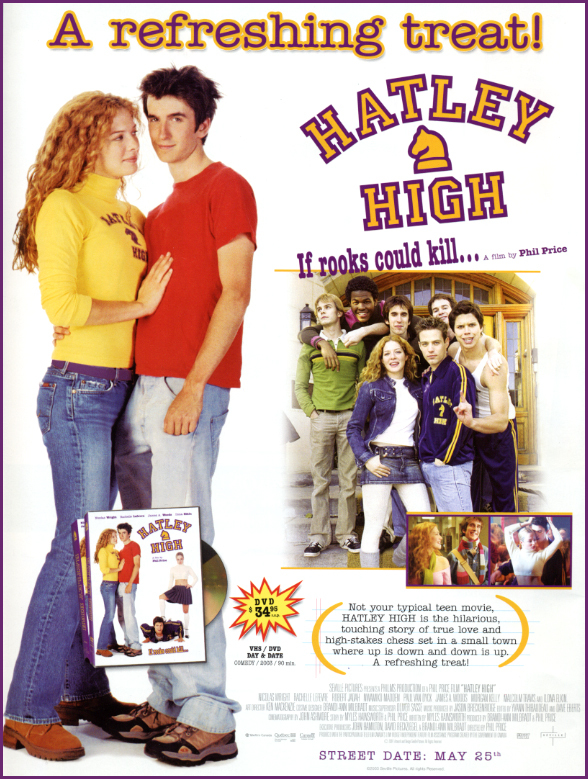
Recently I watched White House Down, one of the biggest box office flops of the year. Going in, I knew it was another paint-by-number Die Hard knockoff, this time set in the White House. But I also knew who some of the supporting cast were, namely former Montrealers Nicolas Wright and Rachelle Lefevre. I can’t vouch for the movie most people saw (those few who bothered to see it), but the movie I was watching was called Hatley High II. It was all about how a grown-up Tommy Linklater secured a job as a White House tour guide, only to be unexpectedly reunited with his high school sweetheart following her failed marriage to Channing Tatum. After lots of shenanigans and property destruction (typical of high-school comedies, only with more brutal gun fights and deaths by fiery explosions) the two reconcile and pick up their romance where they it left, only now with a precocious first-marriage soon-to-be-stepchild in tow.
Hatley High, 2003, followed ten years later by the sequel Hatley High II: White House Down
Nic and Rachelle reunite, hijinks ensue, and the White House burns.
That particular interpretation saw me through the entire 131-minute running time with hardly any brain damage. Now I need to figure out an angle that will get me through the other Die Hard knockoff flop of the year, A Good Day to Die Hard.
Maybe if I pretend Bruce Willis is playing the ghost of John McClane, but he doesn’t realize he’s dead and only his son Jack can see him… Well, it certainly couldn’t make the movie any less plausible.
Still feeling a touch snotty and feverish from a recent head cold, I decided to stay in and finish off my game of Batman: Arkham Origins – a title, already mentioned here, suffering from a bad case of villainitis. It would be easier to make a checklist of the Batman villains who DON’T show up for this particular Christmas-Eve storyline than to mention the dozens who do. Suffice to say, the rogue’s gallery is overly represented, with prominent figures from Batman eras past and present shotgunned at us en masse.
What makes the classic Batman villains the best in the comic-book biz is that they’re all defined by their psychosis rather than some silly super power. Each of them is a dark mirror of The Bat, with every individual representing one fractured part of our protagonist’s own tortured pathology. It’s what made these characters timeless and so open to interesting interpretations and reimaginings over the years.
What defines the modern Batman villains is that they’re all good at martial arts. So they can…I dunno…kick ass and fight and stuff. Not quite the operatic duel of wits that would require the Dark Knight Detective to do much detecting. It’s really all about the punching which, I suppose, is what people look for in this sort of video game.
Now, I did enjoy it. It was one of the rare adventure storyline games I got all the way through, because I actually wanted to see how it ended. Personally, I would have preferred an epilogue with Alfred and Bruce microwaving turkey leftovers after a very long Christmas Eve of fighting crime and not stopping for food or a bathroom break. But it does end well enough.
I won’t pretend to be a game critic here. I’m no Yahtzee Croshaw – I would need to drink far more coffee to hit that manic a pace. But I will say this latest Batman outing has a virulent strain of the You’re-shitting-me-I-have-to-fight-Bane-AGAIN!?! syndrome. Look, I know he was the main baddie from the last movie, but he’s not all that interesting. He’s certainly not (spoiler alert) three boss-fights interesting. Sure, he’s one of the few semi-classic villains who can give Bats a fair fight, but couldn’t we have at least one boss fight that involves knocking a few teeth out of the Riddler’s arrogant head after all those irritating puzzles? Sure it would be one-sided, but it’s not like the game isn’t already feeding the computer nerds this year’s dose of bully-fantasy-fulfilment. Really, I started to feel bad for all those Blackgate escapees I “interrogated” (read “tortured by standing on their heads”) and then pounded into unconsciousness after gleaning some petty nugget of information. They probably had shitty childhoods, a difficult family life and hard economic times to contend with. They just wanted to get home for the holidays and somebody at the prison left the door open. Can you blame them for seizing the opportunity and simply walking out? I can’t. But the Bat can. What a fascist asshole!
After winning my three hundredth ten-on-one street brawl in a row, I found myself longing for my preferred type of video game – the strategic empire-building genre. Is it wrong to daydream about playing another video game while you’re in the middle of one of the biggest releases of the year? It feels like cheating. But if it’s wrong, then I don’t want to be right. Because the game mechanics that were going through my head, even as I pounded faces into blood pudding on the streets of Gotham, were those of the upcoming Banished.
The end credits of most video games today roll for twenty to thirty minutes on average because there are so many people involved. They make movie end credits (which hardly anyone watches either) seem fleeting. When the credits for Banished roll, there’s only going to be one name, and one name only. Because Banished is a solo effort. One guy, doing everything. And the game looks fantastic. It’s a city builder, and although I haven’t played one second of it, I can already tell it’s better than the uber high-profile franchise remake (and legendary disaster) Simcity 2013.
Apparently you need an army of people to design, write, code and release a game as fucked up as the new Simcity. But it looks like one guy can nail it acting alone. I don’t even know the name of this one industry insider who threw up his hands, said “Aw, screw it” and skipped all the bullshit in favour of making precisely the game he wanted to make, but he’s my hero. Banished looks like exactly the sort of game I love to play, designed by someone with an equal taste for the genre. The game is due out any moment between now and the end of the year, and it’s certainly premature for me to endorse something I haven’t had the chance to try. But I’ve been following the devlog for a long time now, and I’m more hyped for this than any of the giant releases due in the next year.
If you’re interested in this type of game at all, I at least hope I’ve made you aware that this exists. Check of the Shining Rock Software website and its various social media links for all the details. This is the one that deserves your day-of-release dollar, not the latest crapfest from EA (the most-hated corporation in America two-years running – congratulations guys, well earned – if it can’t be Monsanto, I’m glad it’s you). Even though the wait through this final play-testing bug-squashing time is excruciating, at least Banished is being properly beta tested, unlike Simcity, which basically charged everybody a fortune for a pre-order of what turned out to be an alpha-test of a game with catastrophic design flaws that could only be fixed with a square-one rethink and a time machine. May Batman stand on all your heads, you bastards.
November blew in with gale force winds. We had a major blow on the first, with all sorts of branches and trees down, usually on somebody’s car. By early evening, I was surprised the power was still on. I was a little wary leaving the house. Much as I enjoy bad weather and high winds, I don’t enjoy having my skull caved in by flying debris. But I had an appointment to make. A summit had been called. And the commute was only a block away.
Despite being only a stone’s throw from my destination, I took a side trip to a local SAQ to buy some wine for the occasion. What’s the point of a meeting of the minds on a stormy day unless we’re braced with a booze-up? Rubble from all the wind was strewn down the aisles of our government-sanctioned-and-run liquor outlet that day. Every time the door opened, more twigs and leaves blew in, making the place look even shabbier than the regulars.
Having secured an old reliable bottle of Californian cab, I walked back down to the street to the house where we were all to meet. I rang the bell while chatting with the other early arrivals. It took a while to realize no one was answering. The power had finally gone out, and with it the doorbell.
Once we finally made it in and all the other invitees had gathered, we settled down to our drink and dinner by copious candle light. I felt like I was in a scene from Barry Lyndon. With no lights or television or computers or other electric-powered gizmos to distract us, it was just a bunch of people talking and connecting. I later compared notes with other people who had the same experience that night in other locations, and we all had a similar reaction. This is what a proper evening of dinner, conversation and interaction should be like.
The meeting, in case you were wondering, was an informal conference for various connected people who work in the film industry in various capacities. We were summoned to offer advice and counsel for someone about to embark on a first short film project. I don’t know how helpful our input was, but I did come away from this meeting with a piece of cautionary advice – not for prospect filmmakers, but for celebrities.
Yes, celebrities, movie stars, big-name actors, take heed. When film industry professionals gather – the lowly people on the totem pole like crew members and writers and handlers – we talk about you. We share stories. Especially horror stories about what a bunch of assholes you can be. You know all that self-centred, star-fit, bullshit you get up to on sets? Well it’s all being mentally recorded by the people around you. And it all becomes stories and tales and anecdotes to be shared over dinner, when the lights are out, the wine is flowing, and we’re left with nothing but the spoken word to amuse each other.
Keep that in mind the next time you want to call a production assistant at home at four in the morning to rant about stupid shit, or the next time you want to have a meltdown because your trailer is one foot shorter in length than that of your co-star, or the next time you insist on being moved to a whole different mansion during a shoot because your wife decided, for no particular reason, that the luxury mansion you’re staying in now is haunted.
Do you really want to be one of those jerk celebrities people tell horrible stories about for years after your feats of petty assholery? You don’t have to be. Be nice, be kind, be considerate, and you can join the ranks of the great celebrities who have nice stories told about them that confirm that not everybody of the super-famous sect are self-absorbed fuckwits.
Because I learned something else that evening during our summit of the lowly. I learned that Ben Kingsley is a fucking awesome dude who’s great to get drunk with. It’s a shame he wasn’t there to tip a glass with us. He would have been welcomed, unlike so many other celebrities of equal stature and lesser class.
During the pre-relaunch atrophy downtime of the blog, a number of bits of relevant news cropped up. Stuff that actually has bearing on my writing and career, as opposed to the general interest stories I feel compelled to comment on (you’ll note I am bravely resisting the urge to jump on the comedy-gold bandwagon that is Rob Ford and his recent unrevealing revelation that he did indeed smoke crack, but only because he was in a drunken stupor).
Let me give these pieces of publishing news their due on the blog before even more time passes.
Then we have the appearance of more Longshot Comics material in L’art de la bande dessinée, which is a rather ginormous encyclopedia of comics that covers everybody who’s anybody. I guess I qualify as a somebody since I’m represented. Flip all the way to page 32 of nearly 600 pages and you’ll see a reprint of one of my Movies in Longshot strips. I know you’ll buy the book just for that.
And for good measure, I need to mention that the fine folks at Proglo Edizioni have released their Italian translation of Longshot Comics Book Two: The Failed Promise of Bradley Gethers. I don’t know when this came out in Italy – the copyright notice is for 2011 – but I got my copies relatively recently. Once again, they offer more slavishly respectful handing of my material that makes me feel like some sort of legit artist who maybe doesn’t deserve to eat shit the way I’m required to in certain other writing endeavours that shall remain nameless (if easily guessable).
There you have it, a quick check list of what’s seen print lately, with no endless, fevered (literally – I was sick) blathering about ancient monetary history. And no mean-spirited levity at the expense of a sad, morbidly obese crackhead who should really be spending his money on a decent tailor rather than booze. Or crack.
Instead, allow me to close with this note of support for the embattled Toronto mayor:
Rob Ford, whatever his flaws, is a vital and essential figure in North American politics. We need him and we need him desperately. Who else, I ask you, can make Governor Chris Christie seem absolutely svelte?
I spend too much of my spare time watching the global financial crisis unfold. It’s become something of a spectator sport for me since the clusterfuck of 2008, and at this point it’s more akin to watching a lingering piece of roadkill gasping for its last breath on the side of the highway than observing history unfold. It’s horrible and troubling but I can’t avert my eyes. With every nation on Earth facing insurmountable debt at the hands of a banking system that was never going to be able to sustain itself, collapse is in the cards and is coming all too soon to a planet near you.
Worst off is the United States which has come to play the role of both biggest victim and most egregious perpetrator of a corrupt and unsustainable system. Seventeen trillion dollars of debt, unrepayable as that obviously is, is just an hors d’oeuvres in this multi-course meal of financial malfeasance. Unfunded liabilities amount for another 200 trillion (no one knows the real number for sure, all we know is that it’s huge and comes to much more than all the money and wealth there is on Earth). The system has failed, the game is over, and it’s time to clear the board and start all over again with something new just as soon as our politicians are forced into so a narrow corner, they’re left with no more moves to keep the match going just one more turn.
After far too many years kicking the can down the road, the American Empire looks about ready to kick the bucket. Their unbacked fiat currency isn’t going to last much longer, but neither is anybody else’s fiat currency. When the American dollar finally goes belly up and the greenback is worth more as campfire fuel than money, everybody is going to feel the pain. The world’s global reserve currency is a terminal patient and the only option left is to keep printing it and digitally summoning it into existence until everyone collectively agrees they don’t want to deal with it anymore and goes looking for a new currency or commodity to do business in.
This is, of course, nothing new. Epic hyperinflation happened in Zimbabwe recently, culminating in the 100 Trillion Dollar Note. Last century it happened with the Weimar Republic and became a key ingredient in pushing Germany towards a Second World War. Track hyperinflation back far enough and you’ll see it’s been cropping up over and over again for millennia.
The collapse of the currency is just one thing in our current political situation that draws comparisons to the decline and fall of the Roman Empire. The problem with these comparisons that keep cropping up is that most of them are factually incorrect. And as an ancient history buff, it irritates me.
Last night I watched the documentary Four Horsemen, which serves as a solid, but rudimentary guide to what’s going wrong in the world today for those who are just starting to wake up to this reality. In it, precious metals expert David Morgan, refers to the collapse of the Roman denarius, saying how it eventually ended up as a bronze coin with a silver wash. The point he was making about the debasement of money is valid, but his description is wrong. The denarius never had to suffer such an indignity. It was dead years before this happened to Roman coinage.
Maybe I’m just being nit-picky, like a Trekkie who wigs out about the technical inconsistencies of the recent J.J. Abrams Star Trek films, but I genuinely believe Roman history should be taught (and taught well) in every high school history class each and every year until students thoroughly understand how empires rise, thrive, decline and fall. It bugs the hell out of me when learned people, trying so hard to inform all the clueless worker bees out there about what’s happening right under their noses, get their ancient history wrong. Comparing America to the Roman Empire can be helpful and informative, but get your facts straight and your comparisons right.
Fact one, for example, is that Roman civilization never really fell, merely changed shape – from kingdom to republic to empire to split empire to eastern empire. The fall of the western half of the empire marked the beginning of the middle ages, but the eastern half persisted. It wasn’t until the Ottoman Turks finally developed big enough canons to smash through the walls of Constantinople, the most heavily defended city in the world, that the empire finally came to a real finish, marking the end of the middle ages. Fact two, it wasn’t pagan decadence or bread and circuses or Roman orgies that caused the decline to happen. The rot didn’t really set in until well after Christianity became the official state religion. Make of that what you will, but it seems to me the solution to Rome’s problems wasn’t fewer orgies or less sexual liberation. And fact three, the debasement of the denarius (and other coins) was a long process that took centuries before hyperinflation really got rolling. Sure, it ended up being a disaster, but Rome did a better job of managing its finances and remaining a solvent empire than we’re doing today. So watch where you’re slinging those comparisons. Rome deserves more credit than to be compared with the accounting mess the United States finds itself in.
For no other reason than I’m on a roll, allow me to give you a rundown on all the layman ever needs to know about ancient hyperinflation and the collapse of Roman currency. I am, after all, the comic artist who made a series called Money Talks featuring the portraits from international notes as characters. So I guess money is another one of those subjects I obsess about – just not in the productive “gotta earn some more of it” way.
The denarius made its first appearance during the Roman Republic, in the year 211 BCE. There had been a few other stabs at coming up with a silver coin denomination, but the denarius won out, probably because it wasn’t far off in size and weight from the silver drachm that had been issued by many Greek citystates and kingdoms for centuries. From the very beginning, it was a pure silver coin, weighing in at a consistent 3.90 grams (by current means of measurement). The design was limited at first, with not a lot of variation. The head of Roma personified or an occasional god appeared on the obverse, while various gods riding a chariot or the Dioscuri typically adorned the reverse.
A denarius from the good old days of the Republic. Roma adorns the obverse, while an ancestor of moneyer M. Sergius Silus rides around carrying a sword and the head of an unfortunate Gallic warrior (this despite having lost an arm in battle).
Those holding the office of moneyer were eventually given more leeway to experiment with designs, and used their term in office to honour the feats and achievements of their ancestors on Roman coinage. The only rule was that no one currently alive could be depicted on a coin. That was what kings did, and Rome, which had been a small kingdom in its earliest days, did not look back on that period fondly once it became a senate-controlled Republic. In fact it was a denarius of Julius Caesar, during his dictator-for-life period, that is sometimes referred to as “the coin that killed Caesar.” He broke the cardinal rule. After a number of issues that only featured his name on the coin, he had a denarius struck with his actual portrait. This was pointed to as proof positive that he had become a full-blown tyrant. “Dictator” was merely a temporary office what was appointed by the senate during times of national emergency. “Dictator-for-life” was an office Caesar claimed for himself with the support of the people of Rome who saw him as a great hero. But tyrants had to go. One mass-stabbing later and the Republic was thrown into a power struggle as various imperators sought to become top dog. Eventually it was Caesar’s nephew Octavius who came out on top. He adopted the title Caesar Augustus and became the first Roman emperor. The senate was kept to fill its democratic role, but now that Rome had become an empire, there was no doubt who had absolute authority at the end of the day.
Julius Caesar was playing by the rules when he just had his name on his coins. His likeness, however, crossed the line.
An imperial denarius of Tiberius, still a few emperors away from initial debasement.
The denarius continued merrily through this tumultuous period, maintaining its weight and purity. The only exception to this was the debased legionary denarii that Mark Antony had struck for his men by a mint that travelled with his army. Everyone knew these coins weren’t as pure as the real thing, so nobody ever tried to horde them for their precious metal content. They saw circulation for centuries, and most examples that exist today are worn to the point that they’re barely recognizable.
A debased and unloved denarius from Mark Antony’s military mint. Despite the wear, it’s still easily identifiable as having been issued in the name of the 19th Legion.
This anomaly aside, the denarius remained untampered with until the fifth Roman emperor, (and one of the worst) Nero. He was the first one to start mucking about with the precious metal content of the coinage, but that’s the kind of shenanigans you can get away with when you’re treated as a god on Earth and have complete authority over everything, including the mints. Initially this was done on the sly, but future emperors became more open about it. The weights and silver content of the denarius became irregular, but it remained a handsome, well-struck coin. Only by the time of Commodus, a rather barking mad, egomaniacal, paranoid and psychopathic emperor, did the denarius start to look a bit rough around the edges. Quality standards, in manufacture if not silver content, were bumped back up during the Severan dynasty that soon followed. But the Severans would also usher in the beginning of the end of the denarius that had been, effectively, the ancient world’s reserve currency for four hundred years at that point.
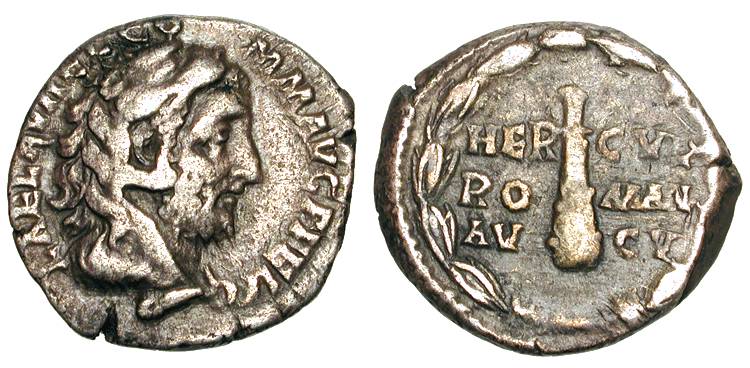
Somewhat shabby, but good as a denarius from Commodus goes. Note the lionskin headdress and club that equates him with Hercules. He thought he was Hercules reborn. What an asshole.
It was Severus Antoninus (“Caracalla” to his friends, but he didn’t really have any friends because he was such a ruthless prick) who introduced a new silver coin in 215 CE. Larger than the denarius, but containing only the same amount of silver, it was put into circulation with the nominal value of two denarii. And the people rejected it. No one knows exactly what the coin was called in its era, but today it’s referred to as the antoninianus or double-denarius. A failure on its initial release, and citizens balked at using any money that claimed to be worth more than a denarius with no increase in its silver content. Caracalla got bumped off a couple of years later for unrelated reasons, and issue of the antoninianus grew spotty. The usurper emperor who followed, Macrinus, issued them, as did Elagabalus once the Severan family seized power again. But it became an on again/off again affair with subsequent emperors.
The antoninianus of Caracalla was defined by the larger size and radiate crown on his portrait.
It wasn’t until the arrival of Gordian III in 238 CE that the antoninianus began to be issued in bulk. In fact, the denomination became so prevalent under this new boy-emperor, the denarius quickly faded away. Quality issues of the denarius did continue in his reign, but vanished utterly by the end of his time on the throne. There are some anecdotal instances of debased denarii making later appearances from various short-lived usurper emperors and breakaway provinces, but they’re exceedingly rare. As of 244 CE, the denarius was effectively dead and gone.
The antoninianus, however, despite being far from a pure silver coin, was still a nice, well-produced piece of currency. We’d be lucky today if our coinage had that amount of hand-crafted artistry and precious metal content. So I’m certainly not knocking the antoninianus. At least, not at this point. Trouble for the coin only really began during the reign of Gallienus. And for good reason. It was during this period, from 253 to 268 CE, that the Crisis of the Third Century kicked in with a vengeance. The Roman empire was beset from all sides – usurpers by the dozen, breakaway fledgling empires absconding with huge tracts of Roman land and wealth. It was a mess. Perhaps most telling for how bad things got was when Gallienus’ own father and co-emperor, Valerian, became the first and only Roman emperor to be captured by the enemy (in this case, the Sasanian shah Shapur I, who reportedly had old Valerian stuffed and taxidermied into a stepping stool that Shapur later used to mount his horse).
The last decent silver-content antoninianii were minted at the Colonia Claudia Ara Agrippinensium mint in what is now Cologne, Germany. One by one, all the mints switched to minting smaller, shabbier, uglier coins. Quality control standards dropped through the floor. Not only did the coins look bad, they went from being largely silver, to almost completely bronze. A token 1-in-20 parts silver remained, making the coins technically billon (a silver-bronze alloy), but they sure looked bronze. Or at least they did once the thin silver wash the coins were coated in wore off in circulation.
One of the last nice antoninianii to be struck in Cologne before it all went to hell.
This issue in the name of Salonina, Gallienus’ wife, was more typical of the transition. The style and strike is notably weaker, the base metal more in evidence, but some of the silver wash remains. Examples get much much worse from here on out.
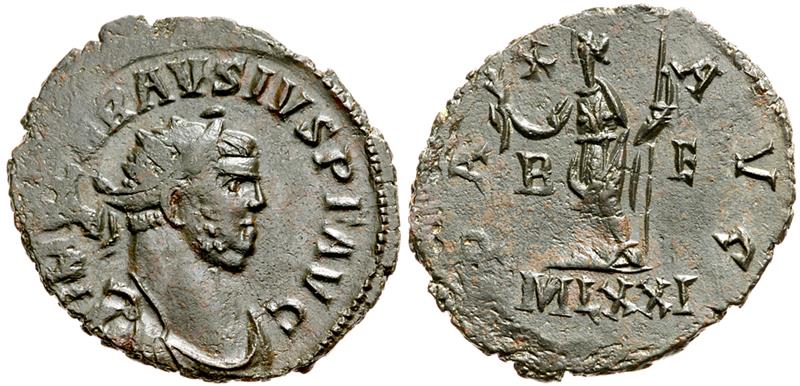
This is actually one of the good examples of an antoninianus from usurper Carausius. His coins are generally so distorted and ugly, they’re indistinguishable from contemporary barbarian imitations of Roman coinage.
Eventually the crisis passed, the empire persisted, breakaway provinces were recaptured, and the quality of the coinage bounced back. At least in appearance. Nice designs and quality die-crafting resumed, although the 1-in-20 parts silver ratio persisted, as did the silver wash which made the coins temporarily shiny but added no actual value. When Diocletian came to power towards the end of the third century, he decided it was high time there was a major currency reform. After the better part of a century in circulation, the over-minted antoninianus was killed off, as was any pretence of precious metal content in the day-to-day currency. A cosmetic silver coating was retained, but most coins spent at the market became plain old bronze. The issues that came out of this period, through Diocletian’s Tetrarchy system of government and the subsequent dynasties that ushered the empire through the entire fourth century, remain somewhat mysterious. Again, we don’t know what the coins were called, but there was a lot of variation in size and weight (with coins that were probably worth the same amount shrinking in size over the course of decades, even though they were struck in cheap base metals). Today we call them AE1 through AE4, depending on nothing more than a few millimeters of diameter difference.
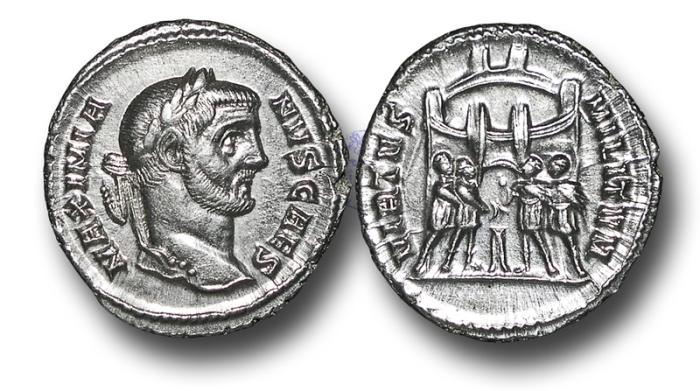
There were token attempts to issue nicer, more valuable coins. The occasional large bronze, clearly meant to be of a higher value than its contemporaries, is noted through to the end of the Constantinian dysnasty. Diocletian, during his reforms, also tried to revive a quality silver coin about the size and weight of the old denarius. It was called the argentus, and it was a very nice coin that only lasted a few years before disappearing. More successful was the later siliqua, yet another silver coin of decent purity and design. Unfortunately, by the time that one came along, precious metal in regular circulation was so rare, most siliqua suffered from coin shaving and clipping by people who tried to keep some of the silver content for themselves before spending the coin at face value. Some siliqua had their edges shaved so severely, the legend is completely gone and only the portrait remains (which, incidentally, is no help at all in identifying the emperor since realistic depictions eventually gave way to generic, idealized, one-face-fits-all portraits).
The argentus was a short-lived return to form for Roman silver.
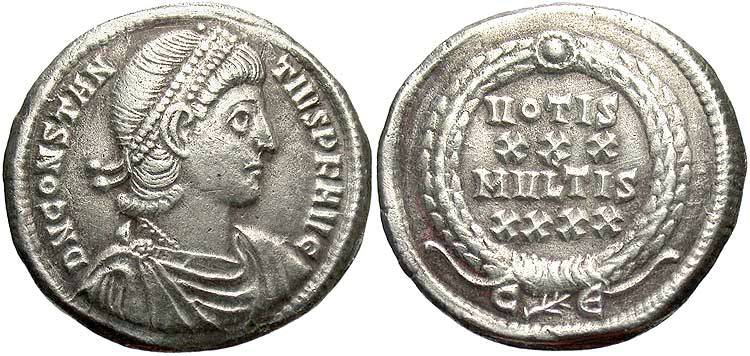
This siliqua of Constantius II survived to modern times without being clipped or shaved.
And what about gold, you might ask? Well, actually, in all this debasement mess, gold remained sound. The standard gold coin, the aureus, eventually gave way to the later solidus, but weight and purity never really suffered much for one reason, and one reason only. Emperors paid their militaries in gold, so they were the very last people to get screwed. An unpaid army is an unhappy army, and emperors ruled only so long as their generals were behind them. Once they lost the support of their soliders, it was knife-in-the-back time and the military coup would result in a whole new emperor, typically chosen from the upper ranks of the men. And the cycle would repeat, over and over again. Few emperors got the chance to die of old age, many reigns were short-lived, yet strangely everybody still seemed to want the top job. But they all knew to pay the army in sound money, no matter how shitty things got. Otherwise their headless body would soon be dragged through the streets and dumped in the Tiber.
The Fall of the Roman Empire is an event usually pinned to the year 476, but this isn’t really accurate. That was just the year when the last remnants of the declining western empire packed it in after years of puppet emperors and barbarian encroachments. The truth is, the power had long-since shifted away from the city of Rome and was now centred in Constantinople in the east. The emperor Constantine had made that the new capital of the Roman Empire back in 337 CE, and Rome itself was really only a nostalgic remnant of past days of glory. By the time it fell, east and west had become two different embodiments of the empire of old, with the city of Rome a rundown depopulated shell of itself. Despite this supposed fall, the eastern empire continued to live and occasionally thrive for another thousand years. We typically call that entity the Byzantine Empire, but it’s a misnomer they got saddled with by a much-later historian who kinda pulled the name out of his ass. What they were was a direct continuation of the Roman Empire (they would have called themselves Romaion and that’s what we would be calling them today if the Byzantine label hadn’t stuck).
By the time the Byzantines came along, the currency was absolutely pathetic. Most coins were tiny, sad little lumps of bronze called nummi, unidentifiable even when freshly struck. Bags of them were required to make purchases of basic goods and services. It was Anastasius, the first emperor to come to power post-Leonid dynasty in 491 CE, who finally sorted things out and stabilized the coinage system with a bunch of new denominations, most notable a large follis that was worth 40 of the discontinued nummi.
Only 11mm wide, this AE4 of Leo I goes to show why something had to be done about the pathetic remnants of a once-proud coinage. At least this one is identifiable by the visible monogram on the reverse. Rare for its time and type.
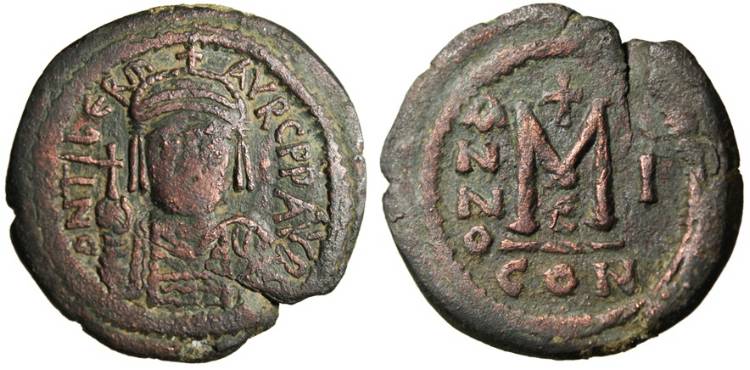
The drab but serviceable Byzantine follis that help stabilize the sad state of late Roman coinage.
It should be noted that Byzantine coinage is pretty damn ugly. Coins were recycled and restruck over each other, making for some jumbled mushy designs. And no one to this day has been able to adequately explain why the later trachy coins were cup-shaped. But given that this was now the middle ages (dark ages to some), everybody’s coinage was pretty shitty. Compared to the wafer thin hammered coins that would come to define the period, at least Byzantine coins felt substantial – even the low denomination spare change.
So in the end, despite screwing up their money, bankrupting an empire, hyperinflating and imploding here and there, the Romans still managed to keep their shit together and muddle through until the Ottomans delivered them their final defeat in the year 1453. If you’re keeping count, that’s well over two thousand years of consistent civilization if you look all the way back to the traditional rise of the Roman kingdom in 753 BCE. Not bad for a people who are, it seems, most famous for “falling.” If you really want to compare the woes of the American Empire to Rome, get back to me when they’ve had that kind of a run. Rome, for its flaws, is still one of history’s greatest success stories. And their money still survives to this day, dug up from farmer’s fields as a matter of routine by metal detectionists. Let’s see how much of today’s paper money survives thousands of years. And as for the digital money… That crap can all disappear as fast is it takes a banker to type the number “0” and hit enter.
There you have it, the not-so-brief history of Roman coinage collapse according to me. You know, I hadn’t planned on writing anything along these lines today. This is just me rattling a bunch of history off the top of my head and I do tend to go on. If you think this is bad, you should engage me in a chat about cinema some time. I simply don’t shut up.
I don’t know what brought it on. Maybe it’s because it’s November 5th, maybe it’s because the million-mask march is happening today. We all have issues with how things are being run, be it domestic NSA spying, TSA strip searches, drone assassinations, or the rise of corporate-controlled fascism. There’s a lot to fix and it’s hard to know where to start. But if we’re going to rewrite the rules of the game, maybe we should begin by reinstating a sound monetary system. At least it will be easier to know who’s winning if the score board isn’t rigged.
Remember, remember! The fifth of November, The Gunpowder treason and plot; I know of no reason Why the Gunpowder treason Should ever be forgot! Guy Fawkes and his companions Did the scheme contrive, To blow the King and Parliament All up alive. Threescore barrels, laid below, To prove old England’s overthrow. But, by God’s providence, him they catch, With a dark lantern, lighting a match! A stick and a stake For King James’s sake! If you won’t give me one, I’ll take two, The better for me, And the worse for you. A rope, a rope, to hang the Pope, A penn’orth of cheese to choke him, A pint of beer to wash it down, And a jolly good fire to burn him. Holloa, boys! holloa, boys! make the bells ring! Holloa, boys! holloa boys! God save the King! Hip, hip, hooor-r-r-ray!
Just when you thought the mainstream news media couldn’t get any more lame, Fox News ups the ante with something that might even trump CNN’s abortive use of hologram reporting. Seriously, hologram reporting. They did that shit once. They beamed the image of their reporters into the studio so it looked like they were actually standing there, next to other reporters who were just standing there for real. This technological leap forward accomplished what journalists scarcely dared dream of for decades – filing a remote report in front of a hologram camera instead of a video camera. Pure genius. Sadly, the experiment failed when every hologram-projection filed proved to be a plea to somebody named Obi-Wan, who was, the reporters assured us, their only hope.
Not to be outdone, Fox News has now given us a studio full of prop-people diligently slaving away at prop-touchscreens. But they aren’t just any touchscreen tablets. No, they’re GIGANTIC touchscreen tablets. Looking akin to King Kong’s iPhone, they fill the set with superfluous techno-bling by the dozen. And the sight is indeed impressive – impressively stupid, instantly dated, and dumb in ways I can’t explain. So I won’t. I’ll let Fox News stooge Shepard Smith explain it himself.
Shepard – Shep to his friends, but he has no friends, so everyone calls him Shemp behind his back – makes a valiant effort to justify the unjustifiable. Apparently Fox hasn’t realized that making their reporting bigger doesn’t make their bullshit any more true than when they tried making it louder.
But what really grabs me about this new set is how much it looks like the modern equivalent of a set from the old Adam West Batman show. Giant props will do that. All they need to do now is shoot it at a slightly askew angle and Shep will instantly be promoted to the level of Batman villain, joining the ranks of The Joker, The Riddler and The Penguin. We just need to give him a better villain name. How about The Stupifier? His nefarious plan is to broadcast disinformation to the world at large, making anyone who watches dumber by the moment. Batman will obviously have to produce some sort of filtering lens from his utility belt in order to combat this devious plot or risk having his reading level lowered to that of a chimpanzee in the “special” third-grader class for slow learners. You know, like regular Fox News viewers.
And speaking of The Dark Knight of Gotham City…
There are no Adam West-era giant props in the new Batman video game, Arkham Origins, but there are villains galore. The premise of this free-range sandbox game is that it’s two years into the bat’s crusade against crime when suddenly, one Christmas Eve, a host of new villains start to come out of the woodwork to replace all those standard-issue mobsters he’s already thwarted.
According to the continuity of this prequel to the two previous Arkham games, we’re to believe that all in one night, Batman has his very first encounter with headliners like Killer Croc, The Penguin, The Riddler, The Mad Hatter, The Joker and at least a dozen other lesser, but still well-established members of his personal rogue’s gallery. Yeah yeah, it’s a video game, but c’mon…plausibility? Just a smidge? I’m sixteen hours into the game and I’m having a hard time suspending my disbelief that this is all supposed to be happening in one night. I know as a kid Christmas Eve seemed to go on forever and Christmas morning was painfully slow in coming, but even last-minute shoppers aren’t this rushed and busy on the 24th.
This game also marks the retirement of the definitive Joker. No, not Heath Ledger or Jack Nicholson or Cesar Romero. I’m talking Mark “Luke Skywalker” Hamill who has been voicing the character for various video game and animation projects for decades. Apparently he took the job to carry him through to his next Star Wars gig. Now that that’s finally in the offing, he’s stepped down as the Clown Prince of Crime and passed the job on to Troy Baker, who doesn’t attempt to reinvent the wheel. Following Hamill’s cue, he’s doing effectively the same voice rather than something entirely new – like Ledger’s weird gravelly Boston-tinged Joker. Given that Hamill so defined what the Joker is supposed to sound like over the past twenty-one years, it’s probably a good decision, if only for continuity purposes.
In other video game news, I’m compelled to mention my Halloween gift came early this year with the October 31 release of the “Blood & Gore” DLC for Total War: Rome II. Total War has long-since become my favourite video game franchise, and I’ve enjoyed every single incarnation of it since the release of Shogun in 2000. It was only with the arrival of Shogun 2 in 2011 that any attention was paid to depicting the bloody mess that was medieval and ancient warfare. Sure, modern warfare is also a bloody mess, but the Total War series has always spared us any forays into that boring mechanized button-pushing morass. Other game series have it well covered. Total War sticks to the swords and arrows and halberds, and long may it continue to do so.
Let us not pretend that getting a pilum in the face circa 100 BCE was a tidy affair.
Oddly, in a series so devoted to realistic ancient battle and tactics, it wasn’t until the Blood Pack DLC of Shogun 2 that they dared show us all the rolling heads and spurting arteries one might expect from hand-to-hand combat. Despite my notorious penchant for gory movies, I’m not as bloodthirsty as some might think. The pleasure I derive from seeing this much blood splashed across my monitor as virtual armies clash isn’t due to sadism, it comes from a desire for more realistic displays of violence in media. War isn’t a clean business. And perhaps if more people got a look at the blood and suffering it entails, particularly in our sanitized news media, there’d be a lot less of it.
Just don’t show it to us on those stupid giant tablets or I might get the giggles.
A typical post-Halloween exchange. This query often comes from friends in Halloween-candy dead zones. You know those neighbourhoods that go dark when the costumed critters come looking for handouts. Such areas, notorious for being the Samhain Scrooges, are avoided by the kids like they’re quarantined, leaving the smattering of jack-o-lanterned, candy-laden households wondering where all the children went.
They went to my neighbourhood.
The area I’m in is known as a Halloween hotspot. Lots of houses give out candy, so kids are assured to get more bang for their buck, scoring sacks of loot without having to cover too much ground. Parents from the dead zones bus them in by the carload, filling our streets with ghost and goblins who only haunt our end of N.D.G. on this one night of the year. They never set foot here otherwise.
As a result, willingness to give out the goods can turn into quite an investment. Every year we buy boxes upon boxes of sugary shit, concerned we’ll never be able to give it all away, and ultimately surprised by how fast it goes. My stated policy remains: Two pieces per kid, smartasses get one. Hardly a generous amount, I know, but even with all those hundreds of individually wrapped sweets, we were cleaned out by quarter past seven, with trick-or-treaters still roaming the street till damn near nine.
Despite the hassle and expense, I always keep the door open on Halloween. Not because I love kids – I don’t – but because I find the occasion to be an indispensable annual survey of the popular mind set. It’s kind of like my version of a government census without anyone having to fill out any annoying forms under legal threat.
There’s much to be gleaned from tallying and gauging the costumes and demographics that arrive at my door. This is how I read our society’s tea leaves once a year. Sometimes I’m pleasantly surprised, sometimes I’m terribly disappointed. For example, despite my threat to punch any kid who showed up dressed as Miley Cyrus square in the face, no such assault was required. I’m still trying to determine if that falls into the “pleasantly surprised” or “terribly disappointed” catagory.
Just as telling as what the children are choosing as their costumes is what they’re not choosing. For example, there were no Batmen or Spidermen this year despite these characters being the number one and two most-popular costumes of recent years. They’ll return of course. Just give them another popular movie release and they’ll be right back in vogue. More tellingly, however – no Harry Potters. Face it Rowling disciples, it’s over.
Here’s my short-form rundown of the evening, taken from memory, and presented here before I forget the details. This is as much for my own records as your entertainment.
Most popular costume: Pirate. Classic, iconic. I approve. Just mind where you’re poking those damn swords. Plastic or not, they’re still pointy and I’d like to keep both my eyes when I’m bending down to give you candy.
Second most popular costume: Zombie. At least the up and coming generation will be prepared and utterly unsurprised when the zombie apocalypse finally happens.
Most popular superhero: Captain America. Which surprised the hell out of me since I’m in Canada. I’ve never seen a Captain America at my door before. And I hope to never see one again.
Most adorable kid: Riley. And not just because she sprang from the loins of two of my oldest friends. She’s simply adorable, especially when compared to most other kids, who generally suck.
Biggest alpha male: The kid dressed as Darth Vader who convinced his two shorter friends or brothers to accompany him dressed as storm-trooper minions.
Number of “I like your pumpkin” compliments: Three. Not much love for my ragged, demented jack-o-lantern design of the year, but I attribute that to having to relocate it to the window due to rain.
Most popular greeting: “Happy Halloween!” Which I hate. The traditional “Trick or treat!” has seen a severe decline over the years, and I heartily disapprove. What is trick-or-treating without a verbal statement of the implied threat? Charity. That’s all it is. Fucking charity. Speaking of which…
Number of UNICEF boxes and the like I had to feed: Six. I abhor these cup-in-hand causes that have employed child labour to do their dirty work and hijacked my favourite pagan festival. But if a kid actually asks (as opposed to merely showing up with a box hanging around their neck) I give. Not to help the charity, but to make the kid feel like they’re doing something worthwhile.
Most ironic request: “Do you have any money for diabetes?”
Number of “Trick or treat, smell my feet, give me something good to eat,” rhymes: Just one. And just one candy for you, you smartass little bastard.
Most bitter kid: We have a tie. Allow me to elaborate.
Mid-evening, two kids travelling together came up the path. They were wearing black bowler hats, black suits, black moustaches, and a pair of matching canes.
“Charlie Chaplin, Charlie Chaplin,” they muttered to themselves all the way to the door.
Holy shit, I thought, these kids are actually dressed up as silent-screen legend Charlie Chaplin. I’ve never seen that before. How charmingly retro! How perfect a way to pander to me! This is awesome! They’re totally getting three pieces of candy each.
Tip for the kids: If you come up my path dressed as either Harold Lloyd or Buster Keaton, you get ALL THE CANDY.
“We’re not Charlie Chaplin,” said the lead kid bitterly before I could offer a greeting. Apparently they’d been getting Charlie Chaplined at every door they rang and were fed up with it. Whoever this Charlie Chaplin dude was, that wasn’t who they were dressed as dammit!
My brain made a quick gear shift as I proceeded to hand them their three candies each regardless.
I hoped having at least one person correctly identify their matching outfits brightened their evening a tad. But their mood didn’t appear to improve any as they skulked away to continue their mistaken-identity candy-collecting death-march.
It wasn’t going to be a Happy Halloween for either of them.
It’s Halloween, the happiest holiday of the year. For ghouls like me, at least. But when it comes to my traditional gorging on horror movies, I’m going to have dip into my own personal collection. Again. The seasonal offerings at theatres are sparse and lame. Ever since the Saw franchise packed it in, we can’t even count on one of those showing up every October like clockwork.
One of the only genre releases in the offing is just another damn remake. And even for a remake, it already feels old. “You Will Know Her Name,” declared all the posters in the ad campaign that started before the glut of summer movies began months ago. I would look at those posters, some of them damn near ten feet long, dangling from the rafters of the local multiplex, and think, “No, actually. No they won’t.”
I’m sorry, I don’t think we’ve met. And you are…?
I knew the film in question was yet another version of Carrie, not some more intriguingly titled terror called You Will Know Her Name (I might have gone to see THAT). But I, unlike, it seems, Hollywood, also knew that the target demographic hasn’t even heard of the original 1976 movie starring Sissy Spacek and Piper Laurie. They probably haven’t even heard of the 2002 television remake, since they would have been infants at the time and nobody was watching NBC back then either.
But they went ahead with their ill-advised ad campaign regardless. And if anybody knows Carrie White’s name now, it’s because they saw it etched on her box-office tombstone. Not a twist ending by anyone’s reckoning. From what I hear, it’s a bland, uninspired and incorrectly cast remake. At least the TV remake had Angela Bettis and Patricia Clarkson, who are both odd enough to bring the creepy. And it had my brother-in-law, Jeremy, as editor. Even at a whopping 132 minutes, it worked, the performances were solid, and the key massacre scene took advantage of what modern special effects could offer. I still fondly remember the high angle shot of the water on the floor rippling away from Carrie’s feet before she proceeded to electrocute everyone. Nice touch.
For the record, I begged (BEGGED) Jeremy to cut that awful coda that had Carrie survive her confrontation with Mother and go on the lam with her buddy, presumable to have a series of Incredible-Hulkesque adventures as they travelled from town to town getting into wacky misadventures due to Carrie’s unfortunate tendency to wig out and commit mass telekinetic murder. But it wasn’t his call. Obviously, somebody had the delusional idea that this TV movie might serve as a pilot for a regular show. The Nielsen people quashed that dream in a hurry.
Start the counter, because eventually we’ll have to endure yet another remake (or bad-idea sequel) of the classic Stephen King story. Carrie is still a marketable name, provided you actually mention that name a few times when you’re trying to build hype for your movie. Seriously, ad-campaign monkeys, if you need me to tell you how to do your job, drop me a line. I’m here to help.
♦
Being of unsound mind and sick sensibilities, I like to follow weird crime stories. Not the kind of boring hot-blonde-chick-goes-missing-in-tropical-paradise crap that CNN likes to beat to death over the course of weeks and months of non-stop coverage. I’m intrigued by the seriously what-the-fuck cases out there. And if it has a Canadian connection, all the better.
Witness all those single running-shoe-clad feet that have been washing up on shore in the Vancouver region for years. That case is awesome! Less so if you’re the owner of one of those wayward unidentified and unmatched feet, but otherwise it ranks a solid ten on the intrigue-o-metre.
Then there’s the truly creepy story of Elisa Lam, the 21-year-old student from Vancouver (yeah, that place again). When the story first broke in February of this year, the news media picked it up and showed some of the footage of her acting strange in an elevator, just a matter of minutes before she would wind up drowned in a rooftop water tower of the infamous Cecil Hotel in L.A. Read more about the Cecil Hotel if you have any doubt that some places seem to naturally draw evil bizarro shit like a magnet. More recently, the whole video has been released, but don’t expect the nightly news to show it to you. Four minutes is too much time to take out of their nightly schedule. It might interfere with the sports-highlights reel.
Elisa was only discovered weeks later when tenants of the hotel complained that the water was an odd colour and tasted funny. Setting the inadvertent liquid-cannibalism aside and ignoring the fact that it was effectively impossible for her body to wind up where it did, least of all if it was a suicide, the creepiness factor rises exponentially when you look at the unexpurgated security cam footage. Way outdoing any of the “found footage” horror movies that have infested the genre since Blair Witch in 1999, knowing where this unsettling video ultimate leads makes it absolutely spine chilling.
Unsurprisingly, the L.A.P.D. didn’t bother to come up with any sort of satisfying or logical conclusion and they’ll never solve the case, just file it away. Morbid armchair detectives will continue to mull over the clues for a long time to come, adding it to the list of horrors that have revolved around the Cecil.
Yeah yeah, I know Halloween is supposed by be about fun frights and silly spookiness. But if you want to see the face of real horror, follow the links. If you dare.
I was a little kid in a distant and mythologized era we now refer to as the ’70s. One day in that dimly-remembered decade, probably around this time of year, I was over at my cousin Debbie’s house. And I was feeling very privileged. Debbie was thirteen and a bunch of her friends were over, hanging out in the basement. Despite the stark age difference, I was not being ostracized as I fully expected to be. Instead, I was permitted to hang with them while they sat in a circle that evening and told ghost stories.
A good ghost story is told exactly the same way you tell a good joke. There’s a setup, a pattern is established, and then a punchline surprises you. Just like the many jokes that are passed down through the generations by oral tradition, ghost stories also rely heavily on who tells them, how the teller embellishes an often familiar tale, and how they perform it for an audience. The highlight of that evening was when one of Debbie’s classmates told his version of the old chestnut about the couple who run out of gas on a country road in the middle of the night, just when reports of an escaped lunatic come over the car radio. There are a million variations of this story, some of them involving a hook hand, some involving a persistent thumping on the roof of the car that lasts all night. The boyfriend character always gets killed, and the girlfriend character is usually driven mad by fear. I had never heard any version of this story before, and I couldn’t even tell you now which version he told that night, but I was mesmerized. And I was inspired.
I desperately wanted to tell a ghost story of my own to entertain everybody, but I didn’t know any. Not one. So I decided to make up one on the spot. The room was hushed, and all ears were on the little kid on the end who had been allowed to sit in with the group of big kids.
The story I told was, as close as I remember, “A bunch of people went to a scary castle and Frankenstein killed them.” There may have been a few more details, but it didn’t run much longer than that.
Ghost-story raconteurs and comedians doing standup share another commonality. They both run the risk of bombing. I remember many blank stares in the basement that night.
“Did you make that up yourself?” one well-meaning big kid asked, obviously enchanted by how adorable I was.
“Yeah,” I shyly admitted. And then I shut up for the rest of the evening. I needed better material and I knew it. Step one, I figured, was to stop being eight years old and grow up so I could develop some sort of frame of reference – preferably by watching lots of horror movies.
A heaping pile of years later, I think I can do a bit better. Witness my more recent attempt at a Frankenstein story. “Monster” was published in the Frankenstein Reassembled anthology a few years ago. With all rights reverted and an agreement struck with artist, Gabriel Morrissette, it now finds a home hosted here at Eyestrain Productions just in time for Halloween. Click through the gallery to read the story and hit the “View full size” button if you want to take a closer look at Gabriel’s fine illustrations.
Welcome to the new, and hopefully improved, eyestrainproductions.com – now powered by WordPress, which I understand is an improvement over what I had before because it’s software that’s still supported and not hopelessly outdated. The problem with the old web site was that it was state-of-the-art ten years ago which, in computer terms, is like saying you’re tearing up the highway with your state-of-the-art ox cart.
Although my homepage has probably lost some of its quaintness, its charm, its low-rez, inadvertently retro hipster irony, I now have a lot more toys to play with, and can offer up all sorts of new types of content without having to go beg a web designer to do free programming for me.
Some of the old content is MIA for the time being, but will make its return soon enough. In the meantime, there’s new content I dreamed of adding to the site long before it became practical to do so. Go explore. You’ll no doubt find new insight into some of my obsessions.
Buying things should be much easier now, with multiple opportunities to add stuff to your cart as you read about some of the old comic work I still have copies of. Or you can go directly to the actual store on the top menu, which is currently sparse in design but straightforward.
The blog now has categories and a search field, making it easier to find topics you enjoy and skip all my other inane babblings. For good measure, I reread all my old postings and corrected some embarrassing typos that I was only able to spot with the distance of time. There are, of course, many many links that have died out or changed in the last decade. I didn’t bother to strip out all those urls that withered away over the years. Just keep in mind, if you’re reading the earlier days of the blog, that once upon a time those links used to send you somewhere cool or relevant.
And speaking of links, I’ve completely changed the old link page. To my horror, I realized the nature of one or two of those sites had switched from something I endorsed, to something I held in contempt – namely, crappy sleazy porn. If I’m going to recommend a link to you, the least I can do is point you at some quality porn.
Bits and pieces of the website remain a work in progress, but nothing is going to lead you to one of those annoying UNDER CONSTRUCTION pages. It’s all there, ready to be added to as time marches on. The remake is officially complete, the heavy lifting is done, and hopefully I won’t have to go through this again for another ten years.









 Eyestrain Productions