Black Chaos

One of my old short stories has just been reprinted in a new anthology of zombie yarns from Big Pulp. Carrion Luggage originally appeared in the collection, Island Dreams: Montreal Writers of the Fantastic in 2003. Usually I’m happy to use this website as a dumping ground for past material, but when I heard about the upcoming untitled anthology (now named Black Chaos: Tales of the Zombie) I thought this might tickle their fancy and offered them the rights. Everyone’s so eager to write new flesh-eating undead stories, the traditional voodoo zombie has become sadly neglected over the years. I figured this story might help fill a void.

blackchaoscoverblackchaosbackBlack Chaos is available in both print and e-book formats from outlets like Amazon. And if this puts you in the mood for a zombie movie or three, why not give the Romero derivatives a break and visit voodoo classics like White Zombie, I Walked with a Zombie, and The Serpent and the Rainbow for a change. I wish there were more entries in the meagre voodoo-zombie sub-genre to recommend, but after those three I’m already stumped. Okay, maybe, just maybe, Live and Let Die, but now I’m really stretching. Comment below if you know of any more.

Three and a Half Stories Tall

“So how’s that writing thing going?”

People generally assume I’m writing something, but if they ask anything specific I shut down, say something trite and sarcastic, and change the subject. Questions about my work like “What’s it called?” or “What’s it about?” tend to only illicit grumpy-bear noises from me. I appreciate that friends and family are interested, but nothing kills a work-in-progress faster than talking about it. If a story comes spilling out of my mouth, it won’t come spilling out of my fingertips and into a keyboard like it’s supposed to. This is a common affliction among writers. If you say it, you won’t write it. Many a terrific story has died a premature death by being spoken out of existence.

Once it’s done, then I can safely blab about it. To that end, there are a couple of new and a couple of old short stories I should mention.

shotgunhoneyAs of today, Table d’hôte is live on Shotgun Honey. This is home to a wide variety of noir flash fiction from authors around the world. Given that their unofficial mascot is Frigga from Thriller: A Cruel Picture (AKA They Call Her One Eye), that legend of Swedish exploitation cinema, I knew I had to submit some material to them. At under 700 words, you should be able to absorb it about as fast as this blog post.

Newly added to the short story section of the Eyestrain homepage is Probe, the very first short story I ever had published, a mere quarter century ago now. It wasn’t my first published work – that happened a year earlier with my scripts for the comic book anthology, Shattered Earth, but we’re still going waaaaaay back into the dusty recesses of the filing cabinet. It’s vaguely cute, kinda funny, so I figured I might as well own up to it and give it a new home.

Underwriter is something much more recent I finished and decided to host here, rather than flog it around to other venues. Mostly because it’s completely self-indulgent. In an effort to exorcise some of the demons from my screenwriting career, I thought I might like to have a go at a few of the meetings I’ve sat through over the years. Yes it’s fiction, but it’s also very much inspired by some sadly all-too-real encounters behind the scenes of the film and television industry. Have fun deciding for yourself how much of it is grotesque exaggeration for comedic effect, and how much of it is grotesque reality for soul-crushing effect.

A little farther down the road, Big Pulp will be reprinting my story, Carrion Luggage (originally from the Island Dreams collection of 2003), in their upcoming zombie anthology. I thought I’d offer it to them because hey, who the hell writes voodoo zombie stories anymore? Apparently nobody. It’s all The Walking/Talking Dead now – George Romero, two generations removed. I figured they’d jump at it as a welcome change of pace to all the flesh eating that goes on with recently reanimated corpses these days. And I was correct. More details (like the actually name of the upcoming collection) will appear in this space when I find out for myself.

I have another half-a-dozen new short stories waiting in the wings as well. I’m still on the fence about exactly what I want to do with them. I feel I should at least go through the motions and give a few of them a fair kick at the can with paying magazines, but my patience with the whole submission process isn’t what it used to be. In the midst of my mid-life crisis (something that’s been going on since I turned 30 – or, if I’m being perfectly honest, 20) I’m less interesting in pursuing the often paltry sums offered for fiction in lieu of just taking the raw material directly to my audience. Editors and gatekeepers too often operate as a barrier between what I write and what ultimately gets read. I feel my material gets filtered quite enough (“butchered” is the more accurate word) in the work I do for the screen. Prose is what I write to relax, so I can say exactly what I mean, warts and all.

I kinda like a good wart every now and then. It adds character.


Tommy Can You See Me?

If you don’t know about the phenomenon of cinematic awfulness that is The Room, I’m not going to reiterate it here. Just go read the wiki article about the film and the madman behind it, Tommy Wiseau.

After watching it once, years ago, I thought I was done. I can’t say I ever climbed on board the ironic-cult bandwagon that surrounds what has become everyone’s favourite bad movie since Plan 9 from Outer Space. If anything, I was always a tad more intrigued by the backstory of After Last Season, a much worse movie on every level, but not as entertainingly bad as The Room. Whereas absolutely everything in After Last Season is wrong (every shot, every line, every prop – something is always so very off), the attraction of The Room is the wrongness Wiseau brings to the proceedings as writer, director, producer and star. Everyone else involved in the film is trying to make sense of it all (including a fair number of genuine industry professionals behind the scenes), but none of them can make any headway against the madness-tsunami that is Wiseau. He tears the whole six-million-dollar self-financed vanity project down around him, and there’s nothing anyone can do to prop it up. It’s fascinating to watch.

Eventually I ended up sitting through The Room a second time when Cindy, a friend since we both worked on Radio Active so very long ago, poked me (literally) for six months, asking, “When are we going to watch The Room?” She had been introduced to a highlight reel on YouTube and had become obsessed. My second screening did not disappoint, and I was enlightened as to the benefit of watching The Room with other people who could share in the laughter and horror.

I figured that was it. But recently, word spread that The Room personified was coming to town. The Dollar Cinema (long misnamed since admission is now $2.50 for regular screenings) was hosting a special event with Tommy Wiseau himself, and co-conspirator, co-star, co-producer Greg Sestero. How could we not go?

A trio of us took an afternoon excursion to the Decarie Square mall – one of those economically depressed shopping malls so dead, it would be perfectly safe to seek shelter there in a Dawn of the Dead scenario. Even the zombies would find better places to hang out during the apocalypse. I’d bought tickets online a few days earlier, and although we’d heard the show had sold out, we were unprepared for the epic crowd.

“This mall hasn’t had this many people in it since the ‘80s,” I declared. And I wasn’t joking. I think that was an accurate assessment. We were the better part of an hour early, and already the line of ticket holders was long. It would double by the time we were let in. There was even a lengthy line of people waiting for standby tickets. An entire second screening had been scheduled to meet demand, and it looked like it would be no less crazy.

An pre-movie opportunity to buy merchandise, meet Tommy and Greg, and get shit signed was offered and seized by Cindy and myself. Knowing there was a recent book about the production by Sestero, I took this moment to buy a copy. I’m halfway through The Disaster Artist now, and it’s kind of magnificent – certainly the best Hollywood-underbelly book I’ve read since Nightmare of Ecstasy. It’s a compelling story in the genre I like to call “Normal guy tries to be buddies with weird guy.” As such, the book is a modern day Of Mice and Men, with Tommy in the role of Lennie, excepting the fact that fewer puppies and pretty girls get accidentally strangled. Okay, maybe it’s just a modern day The Cable Guy. Either way, it’s rocketed to the top of my recommended reading list.

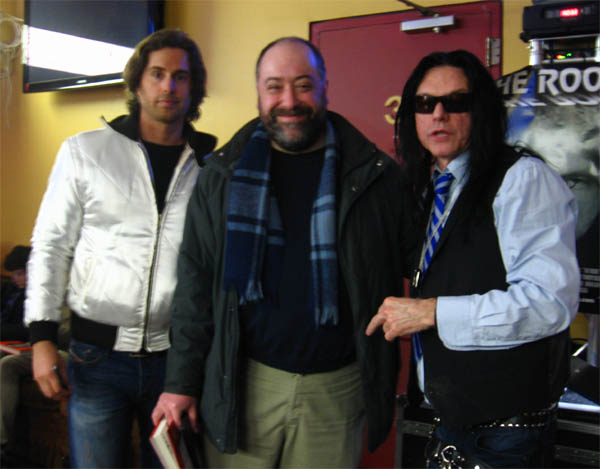
Film industry titans, Greg Sestero, myself and Tommy Wiseau. Photo by Lucinda Davis. NB: Greg is wearing a knockoff of the scorpion jacket worn by Ryan Gosling in Drive. Unless, of course, he defeated Gosling in a duel and skinned him alive.

Film industry titans, Greg Sestero, myself and Tommy Wiseau. Photo by Lucinda Davis. NB: Greg is wearing a knockoff of the scorpion jacket worn by Ryan Gosling in Drive. Unless, of course, he defeated Gosling in a duel and is wearing his skin as a trophy following his victory.

Intriguingly, Greg Sestero crossed out his own name before signing. Insanely, Tommy crossed out co-author Tom Bissell's name before signing.

Intriguingly, Greg Sestero crossed out his own name before signing. Insanely, Tommy crossed out co-author Tom Bissell’s name before signing.

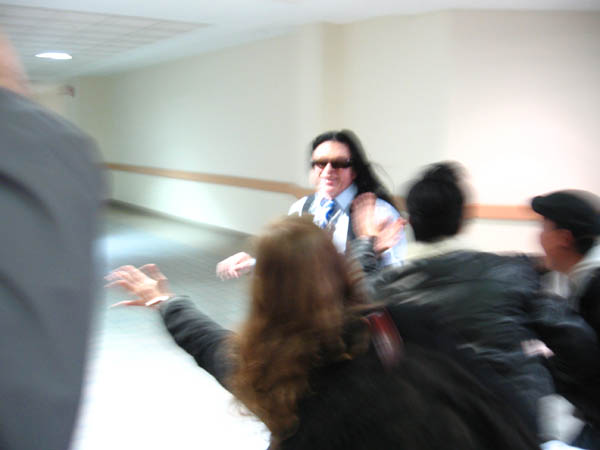
Back outside and in line, we heard the crowd erupt into cheers and hoots. Tommy had decided to come out and bask in the love, running the length of the queue to deliver as many high-fives as he could to his adoring fans. Tommy doesn’t seem to smile much (unless you count those unnerving humourless chuckles from his bag of acting tricks), but there seemed to be genuine joy on his face in this moment. He looked like a big shaggy dog let off his leash in an open field after being cooped up in the house all week.

The Running of the Tommy.

The Running of the Tommy.

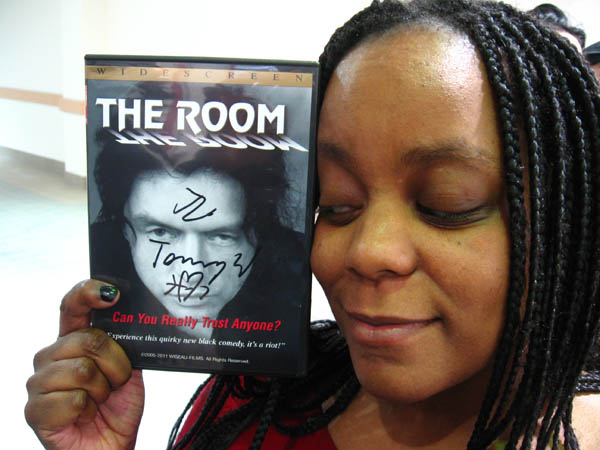
Cindy looks adoringly at her signed DVD. The ladies get an extra heart-and-arrow scribbling on their merchandise.

Cindy looks adoringly at her signed DVD. The ladies get an extra heart-and-arrow scribbling on their merchandise.

Pete models the sexiest piece of Wiseau memorabilia offered to fans. We can only hope each item was pre-worn by Tommy himself. I know I'd rather have his name on my underwear than that goddamn Hilfiger creep.

Pete models the sexiest piece of Wiseau memorabilia offered to fans. We can only hope each item was pre-worn by Tommy himself. I know I’d rather have his name on my underwear than that goddamn Hilfiger creep.

The Running of the Tommy Part II: The Rebound Lap.

The Running of the Tommy Part II: The Rebound Lap.

Inside the theatre, we were subjected to a surreal Q&A session with the featured star duo. I usually find screening Q&As tedious, filled with bad and awkward questions from the audience that really bring the mood down. In this case, nothing could bring the mood down. It didn’t matter what was asked of him, Tommy was quick with answers that came directly from an alien world in an alternate universe. He was multitasking bizarre queries, photo requests, and film-scene re-enactments in a way only someone completely uninhibited can. It’s astonishing how much you can accomplish when you don’t think about anything before you say or do it. Tommy just runs with it, whatever it may be. He may not arrive anywhere that makes the least bit of sense, but dammit, he’ll get there.

The Q&A. We sat near the very back because we didn't want to get pelted by plastic spoons the whole movie. It was a wise move.

The Q&A. We sat near the very back because we didn’t want to get pelted by plastic spoons the whole movie. It was a wise move.

Pete assumes the crash position, doubling over with laughter during Tommy's barking-mad responses. Cindy watches with awe, admiring a true thespian at work.

Pete assumes the crash position, doubling over with laughter during Tommy’s barking-mad responses. Cindy watches with awe, admiring a true thespian at work.

In the decade-plus since its release, The Room has very much arrived at a Rocky Horror level of cult. I knew about the spoons that would be thrown, the footballs, the people who would inevitably arrive dressed as their favourite character. But I didn’t expect the audience interplay with the film to be as solid as it was. There were some classic reply lines, sing-alongs and Mystery Science Theater 3000 moments. In this post-Oscar season, what’s to be said when the most entertaining picture I’ve seen lately is a piece of crap from 2003 I’d already watched twice before?

Of course, in the wake of this, Cindy wants to watch After Last Season, complete with its paper sets, paper MRI machine, and paper-thin acting. I don’t know if it can hope to match the magnificence of The Room should we gather an audience, but I expect we’ll find out soon enough. The poking has begun, and past experience has shown I can only bear that for six months max before my resolve crumbles.

Ad-Dressed

I was outside at 3:00 am last night, pacing back and forth on my stoop in the middle of a winter wind storm, quietly whistling the Mothra song to myself (don’t ask) as I tried to shake off a headache with a combination of fresh air, Advil and tea. It’s in moments like these that I worry some insomniac neighbour will spot me, get creeped out, and summon the police. I make no apologies for being an eccentric, which is challenging because, being Canadian, I feel compelled to apologise for everything.

For the better part of an hour, I walked back and forth on the same stretch of ice, trying not to slip, soaking up the drizzle, and thinking about work. Not the paying kind of work – the stuff that holds me under contract to produce pages on a deadline – but about the work that matters. The work I do for myself.

I still have a tremendous backlog of material that needs to be scanned or edited and then put into the posting queue for Eyestrain Productions. Plus there remain many other projects in various unfinished states that I want to wrap up and get in front of people – specifically, you. Yes, you. Since you’re the target audience, I don’t want to dick around with the middlemen anymore. Visits are up, the number of website followers is on the rise, and I see little benefit in sitting on stories, hoping to place them with some anthology, printed or online, for peanuts. I’ve grown weary of the gatekeepers. My interest in submitting stories to editors who don’t understand my sense of humour, or pitching films and television series to development executives who are – let’s be polite here – short sighted, has waned.

To that end, there’s a new short story called “Special” online. Getting people to read internet fiction is always an uphill battle, so let me entice you in the most cynical way I know how: this one involves cosplay sex. Yeah, it’s a bit pervy. Can you feel the irresistible pull? Don’t resist it, you’ll hurt yourself.

In no way should this be construed as being based on my own experiences signing shit in San Diego and at other comic-book conventions. My time on the bourse floor was never so interesting or rewarding. But there was plenty of inspiration to be had, much of which inevitably filtered down into this story. As usual, you can decide for yourself where reality ends and where my particular brand of bullshit begins.

The Morbidity Before Christmas

It’s Christmas Eve, and is there ever a time when it’s more appropriate to give a gift? Especially if that gift is the wrong size and colour and can’t conveniently be returned to the store for a cash refund? Well I have a very special gift just for you (and whoever else in the world happens to have an internet connection – but really, this one’s expressly from me to you). That’s okay, you didn’t have to get me anything. I’m hard to shop for. An envelope stuffed with cash will do in a pinch, or you can always go hunting for my well-camouflaged donate button, hidden and misnamed at the bottom of my About page where no one will ever stumble across it, even accidentally. No pressure, no guilt.

The present? Oh right, the present. I wrote you story – my new-to-the-public short story, It’s the Thought That Counts – a heartwarming family history that begins, conveniently enough, on Christmas Eve.

Crickets? Do I hear crickets? It’s freezing cold and the snow is ass-deep out there. It seems terribly unseasonable for crickets. I’ll have to look into that.

Before you go diving under the tree for another gift-wrapped box with your name on it, hoping against hope that the next present in line will be way more awesome – something along the lines of socks, underwear, or a tie perhaps – take a closer look at what I just gave you, you ungrateful asshole. It’s free internet content. Okay, it’s not a YouTube video of a cat trying to act cool after pulling down the Christmas tree on top of itself, or your adorable second-cousin’s nephew belching “O Holy Night” after downing three Red Bulls in less than thirty seconds. It’s a bunch of text, which requires much more intellectual heavy lifting to appreciate than a video you can stare at and zone out to. Reading is hard, vegging to viddies is easy. But engaging with the written word is so much more rewarding. And after all, how likely are you to find something as troubling and morbid as one of my stories by randomly surfing YouTube or following the links of your Facebook friends? Well, I guess that depends on your friends. But if you’re looking for some more of that Eyestrain-brand gallows humour for the holidays, it’s only a click away, right here, right now.

Mood-setting clip art in the sidebar aside, the story is, admittedly, a solid block of prose. If you want something with more pictures – of a sort – you can also check out The Awfuls under my new Comic Strips section. I stealthily threw that up on the site a few weeks ago and never made an official announcement here. More strips will follow just as soon as I can be bothered to dig them out of deep storage and fire up the scanner.

When looking for some well-earned time away from your family, their awkward drinking, and their baseless alcohol-fuelled accusations this holiday season, feel free to seek a brief respite here at Eyestrain Productions. Because I’m not going anywhere. The gears of western commerce may have ground for a halt for the Christmas-to-New Year stretch, but I’m still working away late into the night – even though I’m owed money and everybody who can sign their name to my cheques has gone on vacation. The chains to my desk remain locked and my bony fingers still scratch away at the keyboard, day after day. Who has the time for such trifling things as seasonal cheer?

Call me Scrooge if you must, but I’m really only one gimpy kid away from being Bob Cratchit.

Cold Weather, Hot Pennies

It’s an annual ritual: put on winter boots for the first time of the season, take winter boots off, remove cat toy from inside boot, put winter boots back on.

As of last night, Montreal suffered its first of what will inevitably be many snowfalls of the season. It’s an amount of snow that would shut down many cities but barely makes Montrealers blink. The most dire ramifications so far is that it has caused my wife to consider getting her snow tires on, and me to accept that it might be time to remove the air conditioner from my office window. All around town, there was more discussion of the west-island meteor strike a couple of nights ago that everybody but me seemed to have heard. The weather is old news insomuch as it’s always bad news.

Today also marks the mid-point between Halloween and Christmas. What better time than this to share my short story, Hot Pennies, which specifically takes place between these two holiday landmarks. It’s high time I share this publicly since 2013 has also marked the death of the Canadian penny (which figures prominently in the story). Distribution ceased in February of this year and they vanished from daily transactions almost immediately, despite still being legal tender. Another casualty of fiat-based inflation I shall miss.

Rest assured people who were bored witless by my impromptu essay on hyperinflation and the fate of the Roman denarius, Hot Pennies is not a story about coinage. It’s a nostalgic tale inspired by my own childhood. I’ll let you guess for yourselves how much of it may be real. Any similarities to people living is purely coincidental. Any similarities to people dead is most certainly intentional.

‘Cuz fuck ‘em. The dead can’t sue.

Whither Weird War?

In 2011 I wrote a short story for the U.K. horror anthology, Weird War Volume One. After the usual number of delays you’d expect from any publishing venture, final word came down about a fall 2012 launch date. High resolution scans of the splendid cover art were emailed to the writers and we were encouraged to promote the anthology on our various blogs and websites. I held off, preferring to wait until the actual day of publication. And wait I did. Wait we all did.

With a final “publication-imminent this weekend” announcement, things fell dead silent and stayed that way. There was no communication again, ever. The Facebook page became a series of echoing “Well…? Well…?” posts. The promised website relaunch never materialized. It was as if the book, its contents, its editors and its publishers were zapped out of existence, leaving only a faint scorch-mark of a web presence behind. The strangest part of the whole event, at least for someone like me who has been to the publishing blue-balls brothel a few times, was that we’d all been paid in full long ago. It’s not like anyone tried to skip out on dinner when the cheque arrived. We’d been covered, drinks and all.

My sole disappointment was that apparently my story was never going to appear somewhere beneath such a marvelous cover.

Weird War, the anthology that might have been, never was, but might yet be. Or not.

Weird War, the anthology that might have been, never was, but might yet be. Or not.

By the terms of my contract, all rights reverted to me last year. Although I waited patiently, and would happily continue to wait if there were any lines of communication open, I can only assume that something so dreadful happened that the anthology has been cancelled and we’ll never receive word why.

As you may have noticed, there’s a short story section in the main menu of Eyestrain Productions that’s been effectively empty up until now. “Bayonet Baby” has become the first of my short stories to be hosted there. Since I doubt there’s any point in waiting and hoping that Weird War will dig itself out of an early grave, I might as well use this as a venue to let interested parties read the story.

Of course, should I ever hear from the editors again, and receive some good news about Weird War’s revival, I’ll be pleased to pull the story from my website and give them a chance to publish it themselves. It won’t be a first publication anymore, but I can still offer them exclusivity for the duration of the initial run of the book. This isn’t big of me at all. It’s entirely self-serving.

Because I’d really like to have a copy of a book with that cover and my story on my shelf.

Adapt And Survive

The big release of this pre-pre-summer movie season has been The Hunger Games. Ever interested in how books are translated to the screen, I decided to take a day out and give Suzanne Collins’ novel a quick read before heading off to see the film. I’d been told by a number of people that it was basically just a knock-off of Battle Royale, but I went into it with an open mind to see for myself. And you know what? It turns out everybody was wrong. It’s not Battle Royale at all. It’s Battle Royale for chicks. Big difference.

So how do you rewrite Battle Royale for chicks? Apparently all you have to do is spend a lot of your pages talking about food, fashion and makeup. And when it comes time to have your deadly teenagers pitted against each other, you skimp on any details involving the weaponry. A spear is just a spear, a bow is just a bow. If you’re feeling particularly descriptive and want to get all adjectivey, you can dig deep into your meticulously researched notes and specify that it’s a SILVER bow. That’ll paint a picture. Now shut up about the tools of death and tell me about the cupcakes again.

Oh, and if you want your Battle-Royale-For-Chicks book to be a huge whopping success, make sure you throw in a Twilight-style love triangle in which the sullen, plain-Jane has to decide which of the two smitten hunky dreamboats she should choose. Decisions decisions. Have another pastry while you think it over.

As we’ve seen with Harry Potter and Lord of the Rings, when you adapt beloved books in this era, you have to be a little more slavish to the source material than Hollywood has been in the past. Out of necessity, there will have to be a few embellishments and a number of edits to keep the running time reasonable. But gone, it seems, are the days when producers would pay top dollar for a popular series of novels — let’s use James Bond as an example — and then proceed to throw away everything except the title and a few character names. The fanbase for these books is considered to be much of the core audience, and you want good word of mouth to carry your box office. If the opening-day fans tell all their slower-out-of-the-gate fan friends that their favourite book got butchered, you’re going to have a much harder time making it to nine figures. And you might as well forget about the rest of your trilogy (The Golden Compass, anyone?).

After studying the book-to-screen process for many years, I’ve come to the conclusion that the art of adaptation can be summarized in four simple words:

Lucy Mancini’s giant vagina.

Not the four words you were expecting. Obviously. If you thought I was going to go for something trite like “Keep it simple, stupid,” you haven’t been reading my blog for very long. So who is Lucy Mancini and why is her vagina so huge you might ask. Allow me to illuminate.

Check any list of the greatest movies ever made and opinions may vary, but certain staples always make it into the top ten no matter who you talk to. Citizen Kane is invariably right near the top, Seven Samurai will reliably make an appearance, and The Godfather will more than likely snag one of the top three positions. Worthy choices all, and I’m very fond of each of them. Only one of the three is based on any sort of source material, and that’s The Godfather. The film, famously directed by Francis Ford Coppola, was adapted for the screen by Coppola himself, and Mario Puzo, author of the original best-selling novel.

Born in 1920, Mario Puzo grew up in the Hell’s Kitchen neighbourhood of New York. He probably saw enough crime there to tip him towards the mobster genre when he became a novelist and screenwriter as an adult. Although he worked on some decidedly non-mafia-esque projects, like the scripts for Richard Donner’s Superman movies, much of his output was decidedly mobbed-up. Based on his association with the massively successful Godfather film series, Puzo became a well-known writer who is remembered, more often than not, as a great author.

Misremembered.

The fact is, The Godfather is a pretty shitty book. It’s a sleazy little potboiler, full of sex and violence that was destined for the best-seller list because of its lurid content that was seen as rather exotic in its day. If the movie is any good at all, it’s due to the considerable talents of Coppola (already, at this time, an Oscar-winning screenwriter of Patton) as the principal translator of Puzo’s source material. I hold this example up as the finest work ever done in bringing a book to the screen because, remarkably, it’s an utterly faithful adaptation of Puzo’s literary bowel movement.

How is this even possible? Compare the two. The characters are all the same, what happens is virtually identical, even much of the dialogue is directly quoted. So why is the book junk and the movie genius? Context. Although the same things are said and done in both versions of the story, their meanings are completely different from one to the other.

This is best illustrated in the key scene following the failed assassination attempt against Vito Corleone. A response to the crisis must be agreed upon. The hotheaded son, Sonny, wants to hit back hard and kill their enemies. The thoughtful adopted son, Tom, cautions against going to war and wants to lie low. Michael, the enigmatic youngest son, speaks up and surprises the room by offering to broker peace talks that would see him personally assassinate their two main antagonists. The scene is nearly identical in the book and the film and yet they are worlds apart.

Michael’s moral downfall, as he gives up a promising future to toe the family line, is an American tragedy in the film. It’s an upsetting failure that robs the Corleones of legitimacy for at least another generation, and it weighs heavily on everybody. In the book, however, Michael’s fateful decision is seen as an American inevitability. Michael is a mafia thug at heart, and he was just kidding himself that he could be a war hero, marry well, and live an honest life. His moral degradation is of no consequence because he’s only being true to himself. In the movie, Sonny mocks Michael’s earnest decision to kill in the name of the family business. He doesn’t see his little brother as the capable, ruthless mob boss he will soon become as a direct consequence of this moment. In the book, using the same words, Sonny is merely teasing Michael because he’s actually quite delighted that his brother has given up his pretentions and come to terms with his true nature.

The actions are the same, the words are the same, the themes are completely different.

But adaptation isn’t just about finding what you really want to say within the original source material — material that may be at odds with what you want to do with your screen story. It’s also about editing. Specifically it’s about cutting away the dead weight that distracts from what you’re trying to accomplish.

Like Lucy Mancini’s giant vagina.

I’m enough of a Godfather geek that I will occasionally take a couple of days out to watch all three films in quick succession. Yes, the third one too, which could never hope to live up to the first two, but is more worthwhile than the needless critical vitriol would have you believe. As a fanboy, I like to mine new content from these familiar films by tracking the arcs of some of the lesser-known characters that more casual viewers wouldn’t normally notice. Minor players like Michael’s enforcer, Al Neri, or the aforementioned Lucy Mancini who appears briefly in parts one and three. You may remember her as the girl Sonny Corleone is having it off with in the bathroom during Connie’s wedding. She’s barely a blip in the film, but she’s a much more substantial character in the book — to no good effect.

Lucy Mancini’s subplot concerns her involvement with Sonny, and what happens to her after the bloody hit that abruptly ends their relationship. We’re told that the main reason she’s carrying on an affair with such a brutal Mafioso thug is because he’s an oversexed Sicilian with an enormous cock. The only cock, in fact, that’s big enough to make an impact inside her cavernous genitalia. Lucy, it seems, was born rather, um, shall we say, loose.

After Sonny’s untimely demise, Lucy is left with no one to fill the void, so to speak. Ultimately, she departs from New York and the main plotline, but we keep following her story nevertheless. Much of the final third of the book is devoted to Lucy’s journey of despair until she encounters a doctor who is abreast of a radical new surgical technique that offers vaginal tightening. After doubts and reassurances, Lucy goes under the knife and eventually allows her doctor pal to test drive the post-recovery results as they become lovers — something made possible by her sparkling new vagina that is a testament to the wonders of modern medical procedures.

I know what you’re thinking, and yes, all this shit really is in The Godfather. And did I mention this whole plotline goes nowhere and has no impact on the main narrative at all? It eats pages and pages and pages of the book and accomplishes nothing other than to make it even more trashy. I have a theory that Mario Puzo just happened to read an article about vaginal-tightening surgery in the late ‘60s and decided, almost at random, to throw it into whatever he happened to be working on at the time to pad out the page count. It could just as easily have ended up in the first draft screenplay for Superman or Earthquake if he’d read that article a decade later. The thing is, if he’d put it in a first draft of a screenplay, Lucy Mancini’s giant vagina wouldn’t have lived to see the second draft. In a novel, however, that shit made it to print.

Judiciously, Francis Ford Coppola cut the subplot from the film adaptation. I’m willing to bet it was the first cut he made, probably while he was still reading the book. Although Lucy Mancini did make a cameo in The Godfather Part III, details of her vaginal woes were never mined for any Godfather projects, which I find particularly telling since Coppola, ever determined to strip the original book for every nugget of potential plot, went back and used one chapter of exposition as the basis for half of the entire film of The Godfather Part II.

When books get made into movies, I always hear a lot of pissing and moaning about the stuff that was skipped or left out. And yes, sometimes it really is a case of Hollywood butchery. But let’s not forget that there are other examples where judicious omissions not only make for a better film, but make for a classic movie in light of some pretty sub-par source material. Adaptations are made not just by what you put in, but what you leave out. So let us be glad we never had to go to the theatre and be subjected to Lucy Mancini’s giant vagina. Or Tom Fucking Bombadil for that matter.
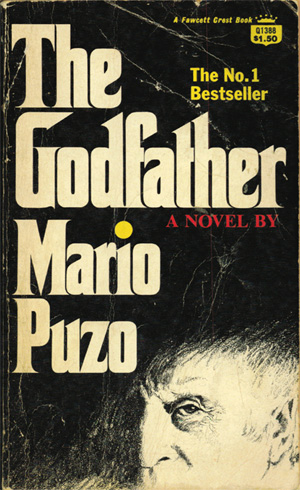
The GodfatherFrom my vast paperback collection: a first print edition from Fawcett (1970). Note the lack of the iconic puppeteer hand and marionette strings that would become the instantly recognizable logo for the franchise once the first movie was released a couple of years later.

The Swarm

“I’ll take ‘Bad Michael Caine’ movies for five hundred, Alex.”

I’ve been swamped — or should I say swarmed — of late. Aside from running around dealing with a bunch of organization and writing tasks, most pressingly I’ve been dealing with that latest invasion of nature in my house.

A couple of years ago, you may remember it was raccoons. This time, it’s wasps. A whole nest of them resides under the exterior paneling above my front door. They’ve been getting into the house lately, much to the delight of my cats and the horror of my wife. After disposing of ten of them in the vestibule one day, I went outside, armed only with a step stool and a vacuum cleaner, and proceeded to suck up another five hundred of the little bastards in one hour flat.

Supposedly, this variety of wasp dies off in the late fall when the queen leaves to find a warm place to hibernate, so the problem should resolve itself soon. I’ll remain on vacuum patrol until then. And one day, once it gets really chilly out, I’ll open up the vacuum cleaner and take the bag to the trash. There’s nothing like a cold day to calm down an eight pound sack of pissed-off wasps.

I’ll try to keep you up to date on a sting-by-sting basis.

*

One of the infrequent attendees at my movie night soiree is Rachel, who made an appearance and stayed for the film this week. With advance knowledge of her presence, I came prepared to exchange gifts. We have an arrangement, you see. She brings me exotic pilsners from the distant land of Saskatchewan every time she visits home and, in exchange, I taunt her about her phobias like a fucking asshole.

Rachel has a thing about broken bones, as I discovered last year when Adam Green‘s film Frozen drove her from the building at the halfway mark. She didn’t quite flee screaming, just cringing and gagging. With that in mind, I brought the infamous movie-night whiteboard filled with the following menu selections:

Finger Breaking Good (1976) – Mobsters try to muscle in on Colonel Sanders’ secret recipe only to find they play for keeps down in Kentucky – one piggy at a time.

The Bone Crusher (1981) – A loan shark grows weary of his job breaking people’s legs and finds a new lease on life when he switches to breaking people’s arms.

Snap Goes the Femur (1990) – The heart-warming true story of a downhill skier who bounces back after a career-ending injury.

Ribbed for Her Pleasure (1995) – A construction worker, pinned under a ton of sheet metal with a crushed rib cage, finds true love with a passing angel of mercy who talks him through his ordeal.

Fractured (2008) – A world famous stuntman refuses to be recruited by the CIA until he breaks every bone in his body during a failed motorcycle jump. How can he say no when they offer him a new identity, a new face, and a new skeleton made out stainless steel?

Rachel stayed for the movie anyway. Mostly because all of the above films are entirely fictional — phony fabrications on my part. For now at least. If there are interested producers out there, I’m available to write any of them for scale.

Call me. We’ll cut a deal.

*

Referring back to those writing tasks I mentioned earlier, there will probably be more multilingual translations of Longshot Comics coming in the near future. Europe keeps on calling and I hope to make some deals while the Eurozone still has a currency to pay me with.

Also, later this year, my short story, Bayonet Baby, will be appearing in the Weird War anthology from War of the Words Press. I’ll post a heads-up once it’s out.

Don’t look at me like that.

I Never Expected To Outlive Anyone

It seems a silly notion to even try to offer up some sort of introduction to who Emru Townsend was. I mean, everybody knew Emru. Really.

Everybody. Knew. Emru.

He was one of the very few people I’ve met in my life who seemed to be connected to every group, sub-group and community in some way shape or form. People usually have to become movie stars to get the kind of notoriety he enjoyed throughout his adult life. I walk in a number of different circles myself, and know whole clusters of people who have no knowledge of the other clusters I’m friendly with. But they all knew Emru in their own way. If you’ve ever watched a cartoon in your life, you probably knew Emru. Or emailed with him. Or at least heard of him.

He was the first animation nut I ever met. Particularly when it came to anime. When Japanese animation was far from being the staple of mainstream North American pop culture it is today, he was a walking encyclopedia on the subject. Even as some of the more notorious anime features crept into limited release over here, Emru was quick to arrange screenings of the original uncut versions so we could get the full experience, unfiltered by the delicate sensibilities of edit-happy distributors.

Emru wrote extensively on the subject and established entire magazines to spread his passion, most notably Frames Per Second, which continues to thrive as a hub for animation fans. The first short story I ever had published was printed by him in his small-press zine, Quark.

If you’ve only recently become aware of Emru Townsend, it was probably because of his headline-making search for compatible bone marrow to combat leukemia, and his efforts to bring more awareness to the need for donors. The campaign blitz he and his ever-adorable sister, Tamu, launched elevated Emru from mere ubiquitous man-about-town to full-fledged media darling.

The last time I saw Emru was almost exactly a year ago. I was on my way to catch the premiere of Lions for Lambs with some friends who had comp tickets. We ran into Emru and Tamu at the theatre and they encouraged us to ditch our tickets and go with them to the premiere of Bee Movie instead. They only had a couple of comps themselves, but a word from Emru was all it took to make a couple more materialize at the guest services desk. In the end, we all agreed we had probably ended up seeing the more political movie of the two.

Afterwards we went to a nearby Canuck-Mex dive for food and drinks. Emru was quick to produce one of his techno-gadgets to show me the latest animation production he was exited about. I updated him about what was going on in the world of Pucca and other cartoons I was working on. As the evening wrapped up, we swapped our latest business cards and promised to keep in touch.

A few weeks later, Emru was diagnosed with leukemia. I watched him fight it through regular updates online and in the media. Given how organized and vigorous his campaign was, it was a relief but hardly a surprise when he found a donor despite the huge odds against it. His cancer wasn’t in remission yet, but they went ahead with the transplant in September to give him the best possible chance. But it was just a chance.

Emru died last night. I’d known him for twenty-two years. He was thirty-nine-years-old.

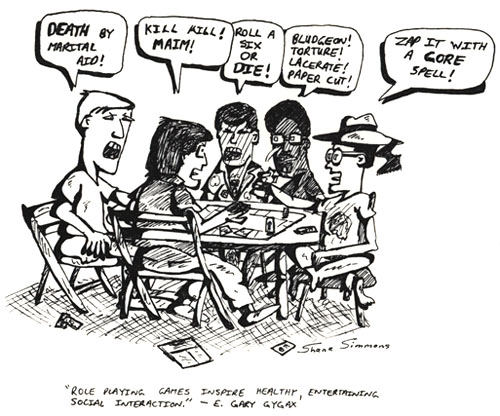
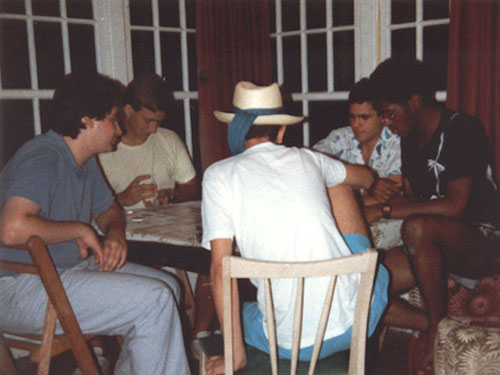
In the summer of 1987, a group of friends got together in a cabin in the woods to drink some beer and play some role playing games. One of them – me – sat out the game to take a photo and draw a picture of the event instead. Emru is the one supplying the much-needed ethnic diversity.